In Search Of... Mike J. Henry
In Search Of... Mike J. Henry
Commodore 64 Pioneer · Software Historian's Account
C64 Copy Protection: The Arms Race
During the 1980s, the Commodore 64 was at the centre of a technological tug-of-war between software publishers trying to prevent piracy and developers creating ever more sophisticated tools to copy protected disks. Commercial C64 titles — especially on the 1541 drive — relied almost entirely on disk-level copy protection rather than serial numbers or manual look-ups. The key techniques were:
- Deliberately corrupted sectors — "Bad" sectors intentionally written so standard Commodore DOS could not reproduce them
- Non-standard track layouts — Odd track numbers, half-tracks, or variable density to confuse regular copiers
- Custom formatting and data patterns — Low-level layouts that generic copy routines could not interpret
- Encrypted or obfuscated loaders — Boot code that verified unusual disk conditions before allowing the program to run
- Fat tracks — Overlapping or abnormally wide tracks that caused standard drive logic to read incorrect data; a term largely coined or popularised by Mike J. Henry himself
Because file-level copiers (which copied via DOS) failed against these schemes, the answer was the nibbler — a tool that read and wrote raw disk data at the bit level, completely bypassing the file system. This is the niche where Fast Hack'em lived: working directly with the 1541's hardware, preserving bad sectors, odd tracks, and custom data patterns, and in advanced modes even recreating the protection on the backup so the software passed its own checks on the copy.
How the Protection Actually Worked
A floppy disk is a circular piece of magnetic film inside a square sleeve. The drive spins it at roughly 300 rpm while a tiny read/write head glides over concentric rings called tracks. Each track is divided into wedge-shaped sections called sectors. The Commodore 1541 formatted a disk with 35 tracks and between 17 and 21 sectors per track depending on the distance from the centre. Every sector begins with a short header block — a few bytes identifying which track and sector it is, followed by a sync mark (ten or more consecutive 1-bits in a row) so the drive knows exactly where to start reading. Then comes the actual data block. Software publishers discovered that if they deliberately mangled this structure in the right ways, standard copying tools would fail.
The most common technique was the deliberate bad sector. A sector whose header or data block had been intentionally destroyed would cause the drive to fail to read it — and when the read/write head failed, it slammed back against its mechanical end-stop and tried again. That is the grinding, banging noise anyone who owned a copy-protected C64 game learned to recognise. It was not the disk dying; it was the protection working as designed. The program would check the drive's error channel on startup: error 21 (no sync character found) or error 27 (checksum error in the header block) confirmed the disk was genuine. A clean backup, lacking the deliberate corruption, would fail the check and crash.
Half-tracks exploited the 1541's stepper motor. Normally the head moved in full-track increments, but the motor could also stop at the halfway point between two standard tracks. A publisher could write data at what would be called track 17.5 — a location the operating system had no concept of, where no standard file copier would ever look. The protection had one elegant property: if you subsequently wrote on the adjacent full tracks, the half-track data was wiped. The scheme depended entirely on the copier not knowing to check between the lines.
Density changes worked at the hardware register level. Address $1C00 inside the 1541 controlled, among other things, how tightly bits were packed onto the magnetic surface — the bit density. By flipping bits 5 and 6 of that register, software could instruct the drive to write a track at a non-standard density, tighter or looser than normal. A regular copier reading the track at standard density would recover garbage. The original disk's boot loader, knowing the density the track had been written at, would set the register correctly before reading.
Extra sectors were possible because the standard track format did not use every byte available. Tracks 18 through 24 normally contained 19 sectors, but by reducing the drive's spindle speed slightly during formatting, more data could be packed over the same physical arc of film — enough room for a 20th sector that the drive's ROM firmware never acknowledged. Similarly, sectors could be written in a non-numeric order; the protection code would verify they appeared in that specific sequence and crash if they did not.
Finally there were tracks 35 through 40. A standard 1541 disk used 35 tracks, but the physical disk surface extended beyond that. The drive head could be pushed out to track 40. Publishers hid protection checksums in tracks 36 and 37, where most copiers of the era simply stopped looking. There was a cost: forcing the head past track 37 risked it jamming physically against the inner stop, which meant opening the drive to free it.
All of this technical vocabulary — bad sectors, half-tracks, density select, sync marks, nibble counting — was largely opaque to ordinary users in 1985. The book that systematically explained it, C-64 Software Protection Revealed by Dell M. and Robert H. Taylor, was published by ValueSoft Inc. at 9513 S.W. Barbur Boulevard, Portland, Oregon. That is four miles from CompuTron Business Systems, where Jim Drew worked and where Mike Henry visited him. Copy protection was, among other things, a Portland cottage industry.
Starpoint Software Era
The Founding: A Ranch in Northern California
Starpoint Software was founded around 1983 in the remote Northern California town of Gazelle (population ~300) by Bruce Quincy Hammond, who grew up on a ranch near Gazelle. Hammond, a self-taught programmer with deep knowledge of the Commodore 64 and 1541 disk drive, assembled a small team of exceptionally talented programmers.
Gazelle/Yreka were unusual locations for a software company — far from Silicon Valley, in rural Siskiyou County near the Oregon border. But this isolation gave the team focus and allowed them to work without the distractions of the tech scene.
The Team
The Pre-History: 1541 Flash! (1983–Early 1984)
Before Starpoint's commercial releases, Bryce Nesbitt had been experimenting with fast-loading systems while working at (or collaborating with) Skyles Electric Works. He created 1541 Flash!, an early fast-loading system that required:
- Replacement DOS ROM in the 1541 drive
- Replacement Kernal ROM for the C64
- A 3-wire cable connecting the user port to the drive
Di-Sector Versions 1.0 & 2.0 (Summer 1984) — The Breakthrough
Di-Sector 2.0, co-authored by Mike J. Henry and Bruce Q. Hammond, was released in mid-1984 and became Starpoint's flagship product. This wasn't just a copier — it was a complete disk manipulation laboratory.
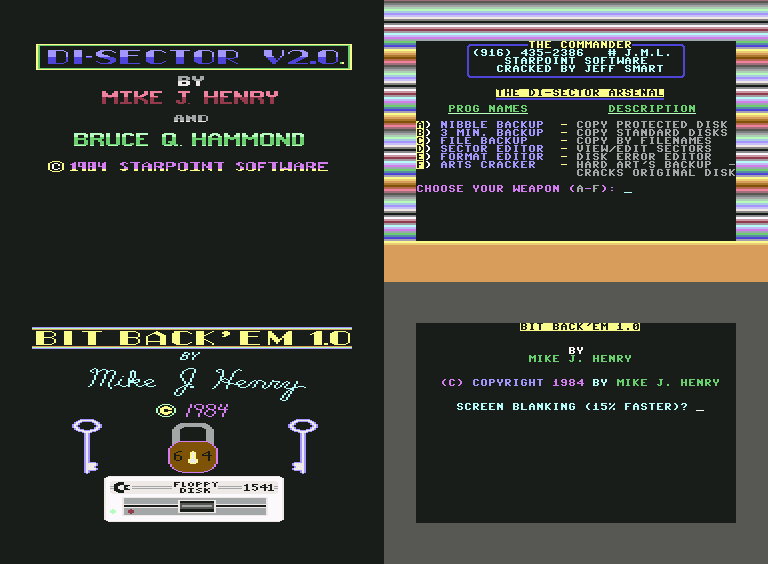
Revolutionary Features
- Nibble copying — Low-level bit-by-bit disk duplication that could handle copy-protected software
- Advanced sector editor — One of the best machine language monitors available for the C64
- Track visualization — Could display and analyze non-standard disk structures
- Parameter-based copying — Users could define custom copy parameters for specific protections
- 15-second format — Incredibly fast disk formatting (standard DOS took ~90 seconds)
- Full DOS support and 1 or 2 drive support
Hidden Easter Egg
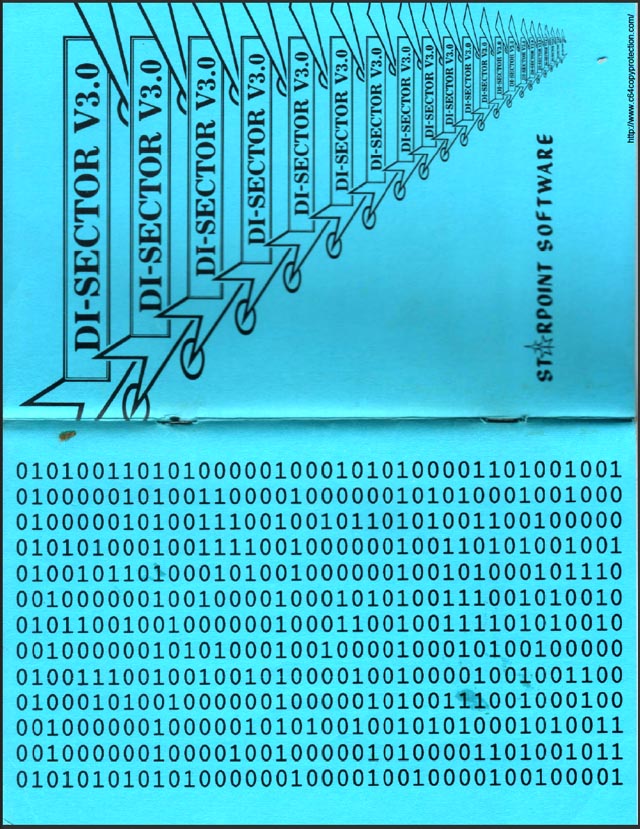
The back cover of the Di-Sector package contained binary code that, when decoded, revealed the message above — confirming Henry's central role in developing the revolutionary nibble copying technology. Image from c64copyprotection.com
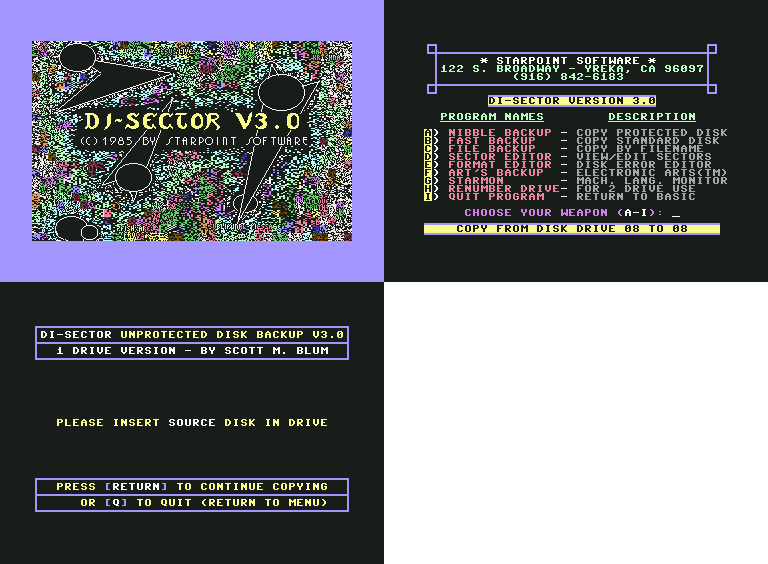
After Mike J. Henry left Starpoint to form Basement Boys Software, Version 3.0 was released, now credited to Bruce Q. Hammond and Scott M. Blum. According to Info Magazine (December 1985/January 1986), "Mike J. Henry struck out on his own after Di-Sector [2.0]." It was during this period that Henry is credited with coining or popularising the term "fat tracks" — describing protections that used overlapping or abnormally wide tracks to confuse drive routines. The term is now standard in C64 copy-protection discussions.
This seems to be accurate. Scott's code seems to indicate a different programming style such as setting $0318/$0319 to reset to the menu, and traditional zero page addresses. Mike's code focused on using unconventional zero page addresses such as $03,$05,$5a and $60.
StarDOS: The Ultimate Fast Loader (1985–1986)
While Di-Sector focused on disk copying and analysis, StarDOS tackled the 1541's notorious slowness. Designed by Bryce Nesbitt, Bruce Q. Hammond, and Scott M. Blum, StarDOS was released in 1985 as a Kernal ROM replacement system with two components: a StarDOS Cartridge (expansion port) and a StarDOS Drive Board (installed inside the 1541).
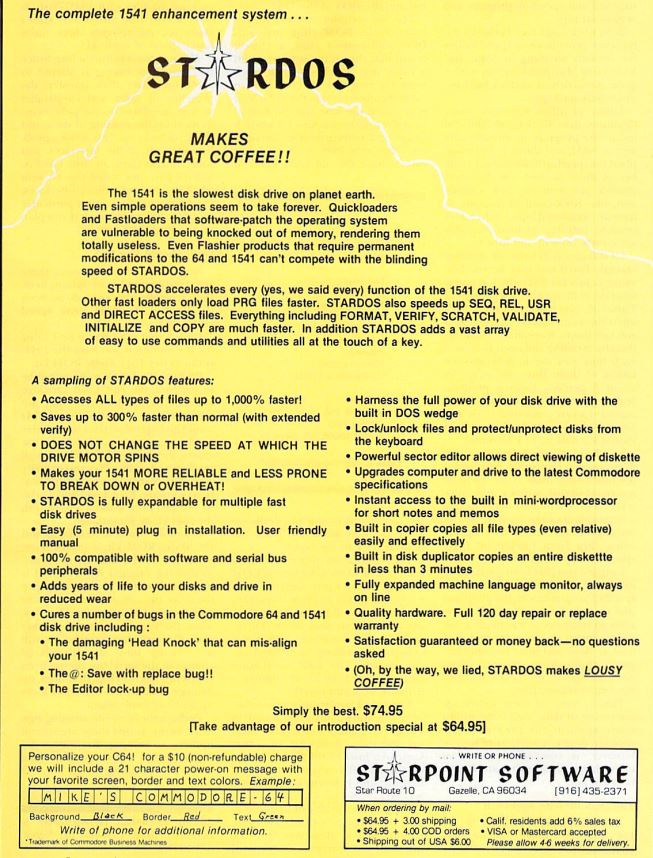
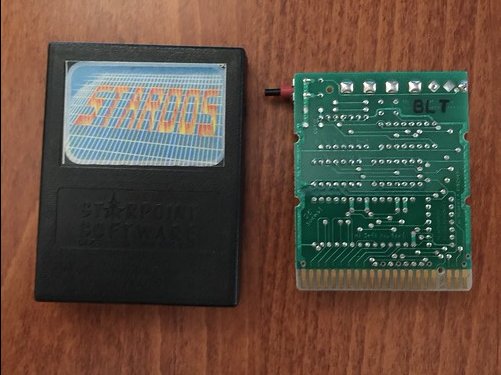 StarDos cart photo by Mark Gladson
Customers could specify their powerup message and preferred colors when ordering. The cartridge PCB contained humorous inscriptions: "Don't you have something better to do!!!" and "Hi Lo Bob Skyles!" StarDOS provided universal acceleration for all file types, enhanced DOS commands, bug fixes for the damaging "head knock" issue, and 100% compatibility with all software.
ISEPIC: The Freeze Cartridge Revolution (June 1985)
In June 1985, Starpoint released ISEPIC (pronounced "ice-pick"), created by Chip Gracey — who later co-founded Parallax Inc. with Lance Walley in 1986 and designed the Propeller microcontroller.
ISEPIC was a "freeze cartridge" that could capture a complete memory snapshot of any running program, save it to disk, reload snapshots instantly, and create standalone versions that didn't require the cartridge.
— Chip Gracey, creator of ISEPIC | Price: ~$49.95 USD
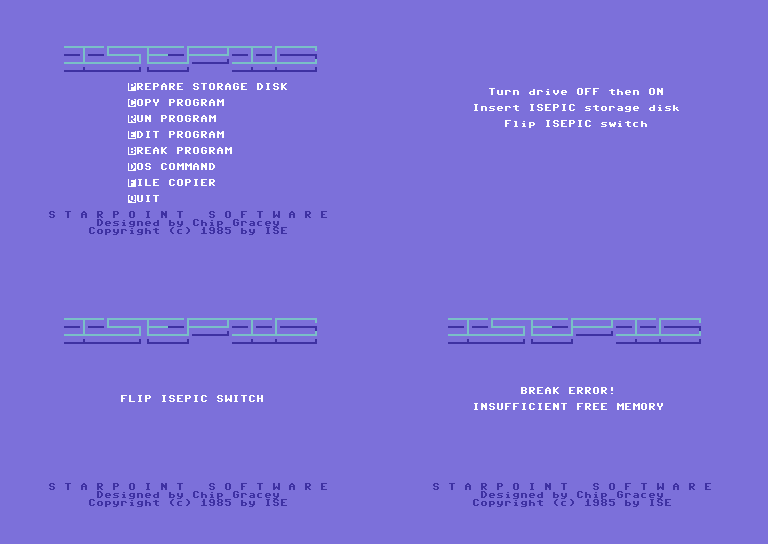
Unlike disk copiers that had to defeat protection schemes, ISEPIC simply captured memory after the protection had already been satisfied — like taking a photograph of a running program. ISEPIC snapshots loaded in ~10 seconds vs. 2–3 minutes for protected originals. The freeze would not work on games that checked for copy protection later in the game (example: Epyx titles).
The Starpoint Team Scatters (1987)
— Kevin Seghetti, 2008 interview | Starpoint closed ~1988–1989
Sadly, Bruce Hammond passed away a few years ago. In 2017, Jim Drew had noted he was still active: "I have been chatting with Bruce Q Hammond about re-creating [StarDOS]. He is checking with his partner who created the code about how we should proceed."
Basement Boys Software Era
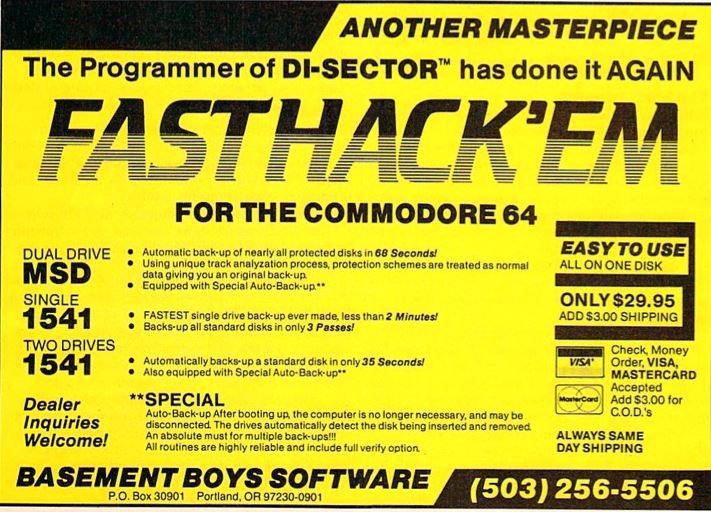
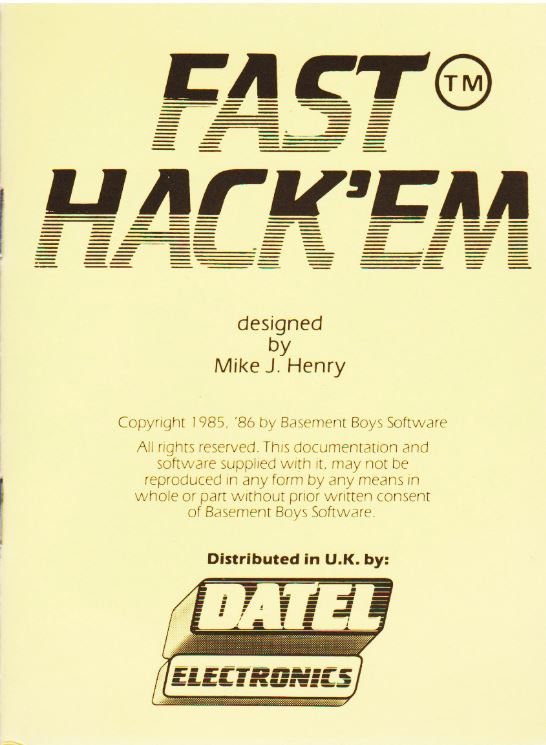
After leaving Starpoint, the programmer operating as "Mike J. Henry" formed Basement Boys Software in Portland, Oregon — likely primarily a one-person operation, though some work may have involved collaboration. The label operated on both sides of the Atlantic: distributed in the US and Canada directly by Basement Boys, and in the UK by Datel Electronics.
Fast Hack'em Version 1.0 (1985) — The Revolution Begins
Fast Hack'em 1.0 was released in 1985 and immediately disrupted the disk copying market. Its combination of raw speed, nibble-level accuracy, and hardware awareness was genuinely new.
Core Features V1.0
- Nibble copying — Bit-level duplication preserving bad sectors, non-standard tracks, and custom data patterns
- Protection recreation — Advanced modes could reapply or simulate the original protection on the backup copy
- MSD SD-2 support — Optimised for the MSD dual-disk drive for even greater throughput
- Parameter system — Users could create and share custom copy parameters
- Text-mode interface — Simple, efficient, no graphics overhead
— Info Magazine, September–October 1985
— Ahoy! Magazine
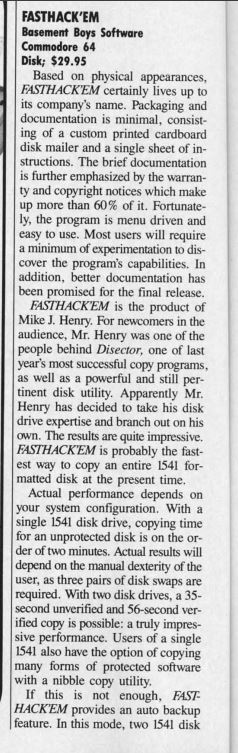
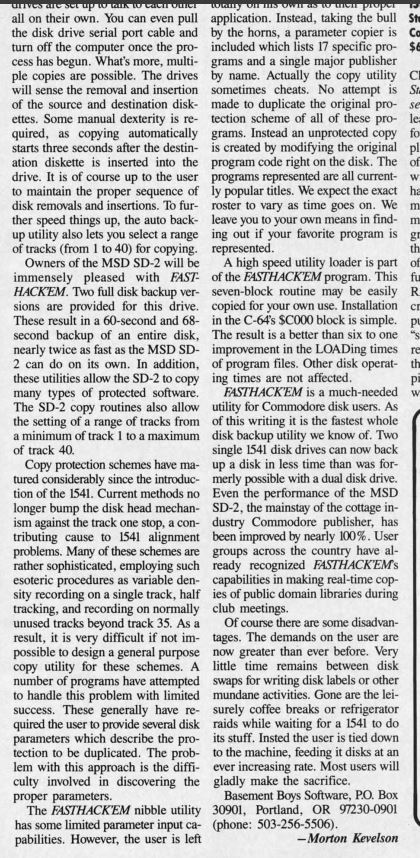
The Killer Feature: Autonomous Drive-to-Drive Mode
This feature cemented Fast Hack'em's legendary status. Once the routine was loaded into drive RAM, the C64 was no longer needed at all.
How It Worked
- Load Fast Hack'em on the C64 and select the two-drive autonomous copy option
- The software uploads custom code into both 1541 drives' onboard RAM
- Disconnect the serial cable from the C64
- Insert source and destination disks — the drives copy independently, indefinitely
Why This Worked
The 1541/1571 drives were essentially complete computers with their own 6502A CPU @ 2 MHz, 2KB RAM, 16KB ROM, and independent serial bus interface. Once the copy routine was installed in their RAM, the drives didn't need the C64 at all. Most likely the drive monitored the write-protect LED to detect when disks were swapped. Exploiting the 1541's internal CPU this way was a demonstration of low-level hardware expertise that few commercial programs came close to.
The Parameter System: Crowdsourced Knowledge
Fast Hack'em's parameter system was revolutionary — a crowdsourced protection database before the internet made this common. Users would analyze new protected games, create small parameter files (<1KB) describing how to duplicate the protection, and share them via BBS systems, user groups, and mail-order services.
Fast Hack'em Final Evolution (V6.0–9.5, 1987–1989)
Version 9.5 (1989) was the final version. By 1989, RAM expansion boards for 1541s enabled more sophisticated copiers like Maverick/Renegade. The C64 market was declining as users moved to Amiga and PC. Rather than fight an unwinnable arms race, Basement Boys pivoted to hardware products.
The last known Basement Boys Software title I could find is FastTrac 128, released in 1990 for the Commodore 128.
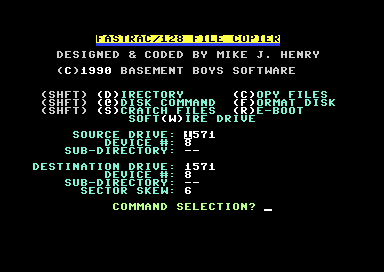
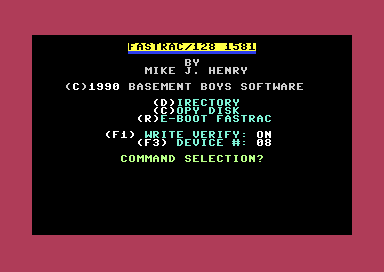
TurboSave 128 — A Complicating Discovery
The April 1987 issue of COMPUTE!'s Gazette (p.70) carried a machine language utility article titled "TurboSave 128", bylined simply as Michael Henry. The utility — written entirely in machine language — accelerated SAVE operations on the Commodore 128 with a 1571 disk drive to up to six times normal speed, saving 64K to a blank formatted disk in 23 seconds.
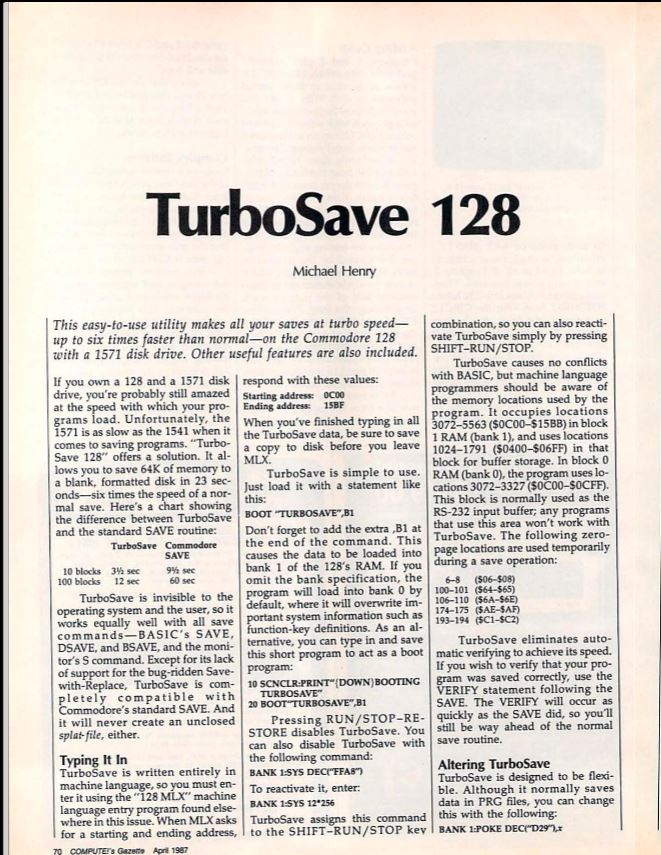
COMPUTE!'s Gazette, April 1987, p.70 — bylined "Michael Henry"
The timing (April 1987) and platform (C128 machine language) align exactly with the Basement Boys era, and the work is technically consistent with the kind of low-level drive optimisation associated with Fast Hack'em. However, the byline is Michael Henry — not "Mike J. Henry" — which raises a genuine question: is this the same person publishing a standalone utility under a slightly different name, or a coincidentally named different programmer? The C128 focus is notable — Basement Boys would go on to release FastTrac 128 for the same platform three years later.
Chip Level Designs Era
Around 1987, Mike of Basement Boys began operating under a second name: Chip Level Designs. The structure was simple: Basement Boys Software handled software products; Chip Level Designs handled hardware products and contract work.
Hardware Products
- The RAMBOard (1988) — Memory expansion for 1541/1571 drives (32KB or 64KB)
- MSD ROM-Based Copier (1989) — ROM replacement for MSD SD-2 drive
- C128 Video RAM Upgrade (1989) — Expanded VDC from 16KB to 64KB
- RapiDOS / RapiDOS Professional — A major 1541 floppy speeder that replaced parts of the C64 and drive firmware to accelerate disk I/O and enable more advanced disk operations. The kernel code was written by Lawrence Hiller (Mr. Nike), who received input from known scene figures including Mitch/ESI. Distributed in the US by Chip Level Designs.
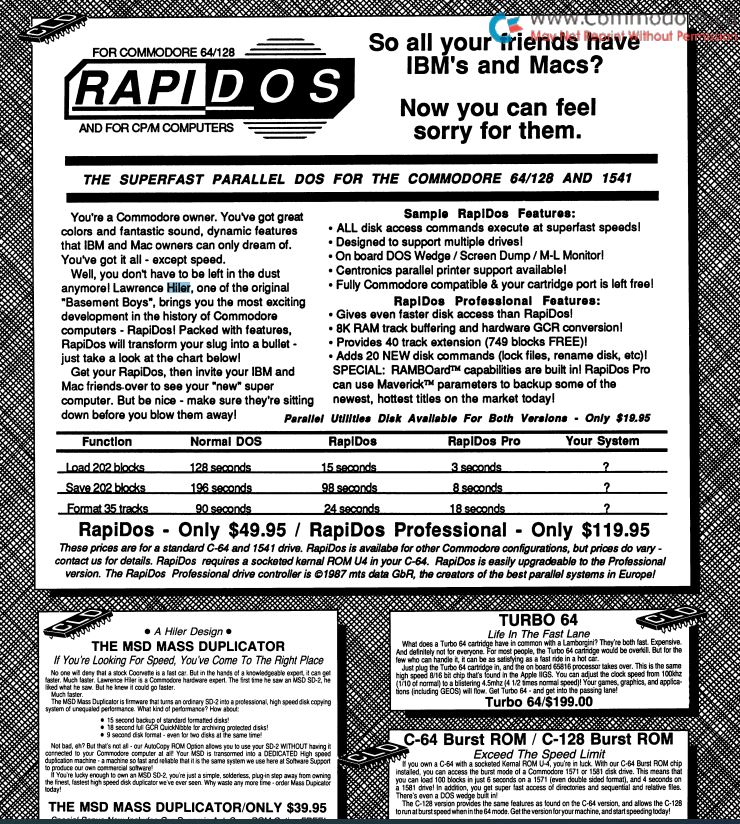 Above:
 "Lawrence Hiler one of the original Basement Boys"
Chip Level Designs partnered with Software Support International (SSI) of Vancouver, Washington for distribution.
Part Three (b) · 1988–1991
Maverick, Kracker Jax & the Les Lawrence Connection
Who Was Kracker Jax?
While Basement Boys was building hardware and Fast Hack'em was reaching its final versions, its closest rival in the C64 disk copier market was a company called Kracker Jax — founded and led by Leslie "Les" Lawrence of Vancouver, Washington. Lawrence's day career was as a chef; he was not a programmer or hacker by trade. His entry into the copy utility market came largely through the Portland-area user group scene, where he attended regular "Pizza Party" meetings at local restaurants alongside Jim Drew (of Kracker Pak / Super Parameters fame) and others who lugged their C64 equipment into pizza parlours to share disks and techniques.
According to Jim Drew, he spent roughly six months teaching Lawrence how to walk through disk loaders and how copy parameters were constructed. Mike Henry, meanwhile, had his own direct relationship with Drew — Henry used to visit Drew in person at his office at CompuTron Business Systems in downtown Portland. Drew later noted simply: "Mike knew a lot."
Lawrence later opened a business inside a software rental store in Vancouver and began competing directly with Drew. Lawrence later opened a business inside a software rental store in Vancouver and began competing directly with Drew. Drew noted a suspiciously familiar pattern in early Kracker Jax parameters — junk bytes he had deliberately inserted into his own Kracker Pak parameters as a trap appeared, unchanged, in Kracker Jax releases. Lawrence acknowledged the naming of "Kracker Jax" was intentional: chosen specifically to cause confusion with Drew's "Kracker Pak" brand. It's the reason Drew eventually rebranded his product as Super Parameters.
— Jim Drew, Lemon64 forum, November 2019
The irony of geography was not lost on the community. The majority of the key players in the C64 copy utility scene — Jim Drew, Les Lawrence, Lawrence Hiler, and their various collaborators — were clustered within roughly ten miles of each other across the Portland, Oregon / Vancouver, Washington area.
Renegade → Maverick: The Next-Generation Copier
Kracker Jax's early approach was specialised: rather than a general-purpose nibbler, they produced targeted copiers tuned to specific software titles. That changed in late 1988 with the release of Renegade — a new general-purpose copier that blended both approaches. The name was quickly changed to Maverick because a C64 game called Renegade was already on the market; early Maverick advertisements still carried a note explaining it was formerly known as Renegade, not to be confused with the game.
Maverick was the product Kracker Jax was best known for and is widely considered the final-generation C64 disk copier of significance. Unlike Fast Hack'em, which had launched in 1985 and still ran a text-mode interface, Maverick featured a fully graphical UI — designed by Wayne Schmidt, a prolific C64 pixel artist — giving it a noticeably more modern feel. It also supported hardware that had not existed when Fast Hack'em first shipped: RAM expansion boards for the 1541/1571 drives and the Commodore 1581 3.5-inch drive.
Authors & Credits
Renegade's original authors were Bob Mills and Mike Howard, based on a design by Les Lawrence. Later versions of Maverick expanded the team to include David Black III, Daniel Hill, and — critically — Lawrence Hiler, confirming a direct working relationship between Kracker Jax and the man behind Fast Hack'em and Basement Boys. Version 5 was modular, allowing users to build a custom Maverick disk containing only the components they needed. The very last release was version 5.04.
The RAMBOard Connection
One of Maverick's headline capabilities — RAM expansion support — was made possible in part by hardware built by Basement Boys' own Chip Level Designs. The RAMBOard, a memory expansion board for 1541 and 1571 drives produced by Chip Level Designs, was among the hardware Maverick was specifically designed to exploit. With a RAMBOard installed, a standard single-sided floppy could be copied with only a single disk swap on a single 1541 — eliminating the need for a second drive for everyday copies.
This suggests a quiet, pragmatic collaboration between the two companies that were nominally rivals in the copier software market. Dave Farquhar, writing on his Silicon Underground blog in 2024, speculated on the logic: the Basement Boys may have decided they were tired of their own software being pirated, and chose to step back from the software side of copying while concentrating on hardware — which was far harder to duplicate. Producing gerber files and having boards fabricated was not something a bedroom pirate could replicate in 1990.
Lawrence Hiler contributing code to Maverick — a direct competitor to Fast Hack'em — while simultaneously building the hardware that Maverick depended on, paints a picture of a very small, tightly interconnected world. These were not faceless corporations; they were a handful of technically gifted people, mostly concentrated around the Portland/Vancouver area, who knew each other, competed with each other, borrowed from each other, and occasionally worked with each other. Les Lawrence and Lawrence Hiler were practically neighbours.
Les Lawrence: The Person Behind Kracker Jax
Les Lawrence's reputation in the community is complicated. Jim Drew, his closest rival, was critical of the way Kracker Jax got started — copying parameters directly from his own work — but also described Lawrence warmly as a person: they shared lunches and dinners at the restaurant where Lawrence worked as a chef, spoke on the phone regularly, and attended the same user group meetings. "I liked Les," Drew wrote. "Before we were competitors we hung out a lot at the user groups. I was saddened by his passing."
A Lemon64 forum contributor who went by "AlienTech" — a former outside contractor who had done parameter and tool work for Kracker Jax — offered a contrasting view, describing Lawrence as among the most honest of the many people he dealt with in the scene. Lawrence paid contractors royalties by contract for copies sold, kept non-disclosure agreements, and gave credit in documentation even if not in advertising. Kracker Jax typically credited its developers in the product manuals rather than in ads or on-screen, which meant many users who pirated Maverick and never saw the manual had no idea who had written it.
Les Lawrence has since passed away. The archival record of Kracker Jax's business — including contracts, non-disclosure agreements, and sales figures — is understood to be held by Nate, a community preservationist who collected Lawrence's archive.
Super Nintendo Era
In 1990–1991, Lawrence Hiller leveraged his 6502 expertise for the Super Nintendo Entertainment System. The transition made perfect technical sense: the SNES used the 65816 processor — a 16-bit evolution of the 6502 with the same basic instruction set. Optimization skills honed inside the 1541's 2KB RAM environment translated directly to the SNES's 128KB.
Basement Boys / Chip Level Designs created sound drivers based on Nintendo's N-SPC/Kankichi system, licensing the technology to multiple game publishers.
Two distinct people don't share the exact same technical credit on the same game — this is the same person entered twice into the database. If "Mike J. Henry" was the commercial label name, studios submitting credits would have used the real working name, which explains why the Hiler profile is the fuller record.
Confirmed SNES Game Credits (~25 titles)
| Title | Year | Platform | Credit |
|---|---|---|---|
| Cal Ripken Jr. Baseball | 1992 | SNES | Sound Driver |
| Road Runner's Death Valley Rally | 1992 | SNES | Very Special Thanks (as MJH) |
| Bulls vs. Blazers | 1992 | SNES | Sound Driver |
| P.T.O. — Pacific Theater of Operations | 1992 | SNES | — |
| Kawasaki Caribbean Challenge | 1993 | SNES | Sound and Music Driver (both names) |
| Dragon Quest III | 1993 | SNES | — |
| The Lion King | 1994 | SNES / Genesis / DOS | Special Thanks to (Chip Level Designs) |
| ESPN Baseball Tonight | 1994 | SNES | Music Driver (both names) |
| Spider-Man | 1994 | SNES | Very Special Thanks |
| ESPN Speed World | 1994 | SNES | Special Thanks to |
| Emmitt Smith Football | 1995 | SNES | Thanks To |
| Earthworm Jim 2 | 1995 | SNES | Development Tools |
| Mo Hawk & Headphone Jack | 1995 | SNES | Special Thanks (both names) |
| Porky Pig's Haunted Holiday | 1995 | SNES | Thanks to (at Chip Level Designs) |
| Ms. Pac-Man | 1996 | SNES | Thanks To |
| Earthworm Jim 1 & 2: The Whole Can 'O Worms | 1996 | DOS | Development Tools By |
| + additional titles. Sources: MobyGames ID 141056 (Mike J. Henry) and ID 101474 (Lawrence Hiler) | |||
Although Basement Boys stopped producing after FastTrac 128, their name was hidden in a few game ROMs (Cool Spot and Bubsy Claws)
The Disappearance & Legacy
Lawrence Hiller: The Identity Question
It's at this point of the article I dive into the question everyone wants to know, WHO WAS MIKE J. HENRY? The working consensus among C64 historians is that "Mike J. Henry" was a commercial credit name throughout the Commodore 64 era — making Basement Boys Software likely a one-person operation under multiple names. Some people speculate that Mike J Henry is really Lawrence Hiler. As one enthusiast put it, "They're like Clark Kent and Superman, never to be seen in the same place at the same time."
There are minor similarities in the Mr. Nike and Lawrence BASIC utilities such as "POKE198,.:WAIT198,1" but this was an early pseudonym. :)
The Origin Story: "Bandit Boy"
According to legend, Lawrence Hiller had been active in the C64 cracking scene under the alias "Bandit Boy" before working at Starpoint. Evidence includes a widely circulated crack of Blue Max (1983) credited to "Bandit Boy." However, the scene profile indicates this persona belongs to a Sysop named Chris who resided in Tennessee. Furthermore, an ISEPIC'd freeze-crack of Dragon's Lair attributed to The Bandit Boy from 1987 would be unlikely from an accomplished cracker of Lawrence's caliber.
In my opinion, I think Lawrence Hiler and Michael J. Henry were one in the same :)
Through publicly available records I was able to confirm enough of Lawrence's background to be confident in the timeline presented here as well as family whereabouts. Out of respect for his privacy and that of his family, those details stay off the page. I'll only say that he attended college in Phoenix around 1983, and returned to the Pacific Northwest approximately 1985–86 to start up Basement Boys Software.
As to the question, who was Mike J Henry, unfortunately the answer seems to be anyone's guess.
If either of you ever stumbles across this — I'd genuinely love to hear stories of those days.
The Preservation Irony
Tools designed to circumvent copy protection now enable preservation. Many C64 programs survive only as Fast Hack'em copies. Original disks are dying — magnetic media fails after 40+ years. Nibble copies may be all that remains.
The pirate's tools have become the archivist's essentials — a fitting irony for software that always straddled the boundary between legitimate backup and illicit copying.
Together, through Starpoint Software and later Basement Boys, they demonstrated the 1541's true capabilities, created tools that enabled both piracy and preservation, trained a generation of programmers, and left a legacy still relevant to digital preservation debates today.
Their work exists in moral gray areas — simultaneously destructive and preservative, enabling piracy while now saving software heritage. This duality makes them emblematic of 1980s home computing, where bedroom coders could create tools rivaling major corporations, and the line between hacker ingenuity and copyright violation was deliberately blurred.
a fitting irony for software that always straddled boundaries."
Sources & References
Primary Sources
- Kevin Seghetti Interview (2008) — Game Developer Research Institute
- c64copyprotection.com — Basement Boys Software (Info article scan & community comments)
- c64copyprotection.com — Fat Tracks terminology
- Dave Farquhar's Silicon Underground blog
- Nick Skrepetos Interview (2022)
- Jim Drew & AlienTech, Lemon64 forums — V-Max thread, November 2019 (Kracker Jax / Les Lawrence recollections)
- Jim Drew, AtariAge forums — "Jim Drew opens website + info on SuperCard Pro", November 2013 (Mike J. Henry / CompuTron Business Systems detail)
Technical Documentation
- Dell M. Taylor & Robert H. Taylor, C-64 Software Protection Revealed, ValueSoft Inc., Portland, Oregon, 1985 — primary source on 1541 protection techniques (bad sectors, half-tracks, density changes, non-standard sectors, tracks 35–40)
- ReplayResources StarDOS documentation
- Parameter Cross-Reference Library (Vol. 1–8)
- Wikipedia — Fast Hack'em
- World of Jani — RapiDOS / RapiDOS Professional (kernel code by Lawrence Hiller / Mr. Nike)
- CommVEX 2005 notes — Lawrence Hiller identified as Mr. Nike of Basement Boys Software
Magazine Archives
- Info Magazine (1985–1989)
- Ahoy! Magazine (1984–1989)
- COMPUTE!'s Gazette (1984–1990) — including "TurboSave 128" by Michael Henry, April 1987, p.70
- RUN Magazine (1984–1992)
Preservation
- Video Game Music Preservation Foundation
- DLH's Commodore Archive
- Internet Archive
- Lemon64 forums
I can confirm that Mike J. Henry is a real person. I used to be in a Commodore user group in Portland Oregon with him. He was an avid cyclist and biked over to our house on a couple occasions. I've been to his grandmothers house where he lived at age 17, if I remember correctly. On one visit, I met a couple of his friends from school who were working for him, taking phone orders, packaging and shipping. I also went to the house he bought after (making a deal with StarPoint Software) on two different occasions.
Excellent research. Thank you. It's a really intriguing and somewhat mysterious part of computer history. I hope some day the true story is told by those who lived it. But who knows, perhaps the mystery is the way it was always supposed to be. ;-)