Copy Tools & Software Reference
This section documents the major copying utilities available for the Commodore 64 during the commercial era of copy protection (roughly 1983–1993). These break down into a few types: fast (data) copiers, GCR nybble copiers, parameter copier systems, special-format copiers targeting specific protection schemes, hardware copiers requiring physical drive modification, cartridge-based copiers, and error/sector editing utilities. Most serious users kept tools from several of these categories. Nothing handled every situation.
Fast Copiers — Standard Format Disk Duplication
Before FCopy, copying a 170 KB Commodore disk took over 25 minutes. Thomas Tempelmann changed that in 1983 by reverse-engineering the 1541's 16 KB ROM firmware — without any Commodore documentation — and replacing the serial handshaking code with fixed-timing routines that ran all four serial lines simultaneously. The result: a full disk copy in 8 minutes (v1), then ~4.5 minutes (v2). An accidental side-effect was that FCopy silently skipped unreadable sectors, writing bad CRC values rather than halting — inadvertently bypassing most early bad-sector copy protections. Tempelmann's full account is on pagetable.com.
FCopy is also among the most technically ambitious nibblers ever written for the platform. Where other nibblers buffered track data in drive RAM then transferred it over the serial bus, FCopy streamed raw GCR data live from the disk head directly to the C64 via a parallel cable, at a rate close to the disk's 300 RPM rotational speed. Because GCR encoding expands data (each 4 bits → 5 bits), FCopy required four passes per track and also required SpeedDOS ROMs installed in both the C64 and the 1541. Version 3.0 is dated 1984, making it one of the earliest parallel-cable nibblers. Enormously influential in the German C64 scene; essentially unknown in the US. FCopy could handle most protection schemes of its era including extra tracks and non-standard formats, though it struggled with V-MAX! v3+.
After reverse-engineering FCopy, programmer Mike Pall (later the author of LuaJIT) took the speed ceiling off by doing something FCopy couldn't: requiring a parallel cable soldered directly to VIA #1 of the 1541 and plugged into the C64's User Port. This bypassed the serial bus entirely, and with it the speed limit it imposed.
The trick that made it work: instead of decoding GCR data on the drive side (which is slow), Pall transferred the raw GCR bytes directly off the disk head to the C64 as fast as they came. The drive's 6502 used the hardware SO (Set Overflow) pin — wired to the disk head's shift register — to detect when a new byte was ready with minimal latency, then fired it over the parallel cable immediately. The C64 and the drive checksummed the data in parallel while this was happening; there weren't enough spare CPU cycles on either side to do it any other way. The transfer ran asynchronously, compensating in real time for the slightly different clock frequencies of the two 6502 CPUs.
The result: a 35-track disk read or written in ~7.5 seconds per pass. Because raw GCR takes more memory than decoded data (684 × 325 bytes per pass), 4 passes were needed per disk instead of the 3 passes decoded-GCR copiers used — but since each pass ran at full 300 RPM (5 tracks per second plus stepper time), the total disk copy time was around 15 seconds. The catch: you had to physically swap the disk seven times, roughly every two seconds. A second person helping was strongly recommended.
Pall released it for free. Like Tempelmann before him, he watched it return in dozens of mutations — credits stripped, group intros added, commercial parallel-cable kits bragging "Backups in 15 seconds!" while having changed only the screen colours and added dongle checks. The copy routines were left completely untouched, presumably because they were too tightly cycle-counted to safely modify. Pall later wrote that this experience was a direct reason he turned to open source software development. His full account, including annotated assembly listings of all four inner I/O loops, is on pagetable.com.
bvc * ; wait for shift register to fill (SO pin sets overflow flag)
clv ; clear it so we can detect the next fill
lda $1c01 ; read raw GCR byte from disk head
sta $1801 ; blast it straight to C64 via parallel cable
inc $1800 ; toggle handshake pin so C64 knows a byte arrived
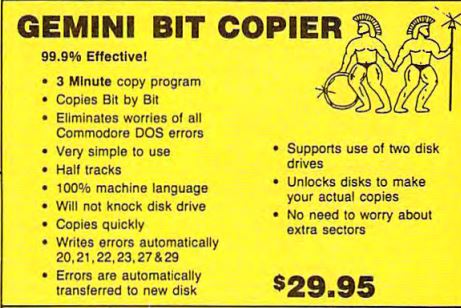
Gemini was written by Jim Drew alongside collaborators Steve Bern and Darryl Millard — all three names appear in the program's credits screen. Drew himself confirmed in a Lemon64 forum post that v1 was released in early 1984 and v2 in January 1985, making Gemini one of the earliest dedicated fast copiers for the C64/1541. It was Drew's first major release before he went on to write Apollo, Keymaster, Copy II 64 v3.0, and SuperCard.
Gemini operated as a single- or dual-drive fast copier for standard CBM DOS disks. Version 1 was a straightforward track-by-track copier; v2 improved transfer speed and added rudimentary error detection — it reported errors encountered but could not reproduce them on the copy. No nybble capability. Used primarily as a clean, fast backup tool for personal data disks before the protection arms race demanded more powerful tools.
Also written by Jim Drew — confirmed in the same Lemon64 post where he identified Gemini. Apollo followed Gemini as Drew's next copier and was notable for a single-pass single-drive copy approach: it maximised drive RAM usage to hold as many sectors as possible per pass, reducing the number of disk swaps required. Standard CBM DOS format only; no error reproduction or nybble capability. Distributed commercially in the mid-1980s alongside Gemini. (Note: Who wrote this? The program credits show Thomas Templemann and Michael Schaff)
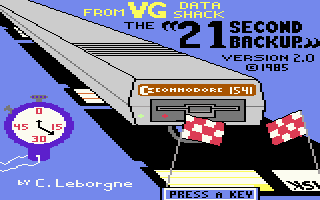
21 Second Backup was written by Charles Leborgne and published by VG Data Shack, based on the south shore of Montreal, Quebec. The title screen — showing a stretched, cartoonish Commodore 1541 drive — was a distinctive visual marker of the program. Confirmed versions are v2.0 (Third Edition, 1985) and v4.1 (the final version); a "v2.0 Modified" variant is also documented. VG Data Shack also published a Super Fast File Copier and a loading accelerator called SpeedLoad, all by Leborgne. By 1987–89 Leborgne had left the Commodore market entirely, moving on to PC development and 68k programming.
The program required a parallel cable connected between the C64's User Port and VIA #1 of the 1541 drive — the same hardware used by 15 Second Copy and Turbo Nibbler (EuroSystems). Both the copier and the file copier companion were heavily advertised in Compute!'s Gazette. Despite this, Pete Rittwage noted he had never seen a clean original — it was widely pirated. The 1571 drive was not supported.
Both the 21 Second Backup and the Super Fast File Copier used an extraordinarily sophisticated copy protection scheme — considered among the hardest ever implemented on the C64. Leborgne exploited the fact that no two 1541 drives spin at exactly the same speed. The protection involved reading data while stepping the drive head — effectively a spiral track verification — and checking how much data was recorded during the track transition. Because this quantity varied slightly from drive to drive and even from one load to the next on the same drive, a copy made on a different drive would fail the check. Users with original disks reported that misalignment of even a single drive could cause the originals to stop loading. As of 2024 the original preservation community considers v2.0 and v4.1 to be among the most difficult C64 programs ever documented.
A straightforward fast copier in the same tradition as 21 Second Backup and Gemini. Kwik-Copy prioritized simplicity and speed for standard format disks; no error tracking or nybble capability. Targeted at users who needed to make frequent personal data backups and wanted minimal menu complexity. Documentation was typically a single sheet. Not a significant tool for protected software.
Copy-Q is one of the more technically interesting C64 copiers because each of its three versions took a fundamentally different architectural approach — and we have a first-person account from "Doug R," a co-author of v1 and v2 who wrote the code that ran inside the 1541 drive, left in a comment on c64copyprotection.com in 2019.
Version 1 was not a nibbler at all. Its key innovation was formatting the target disk with the correct errors before writing the data to it — on the fly, during the copy. No other copier at the time did this. The drive-side code in the 1541's RAM could also edit the sector error list, placing specific error types on specific tracks and sectors individually. The program maximised usable RAM by mapping under the ROM and I/O area; if all the data fit in that buffer (often the case), the program would ask if the user wanted to make more copies — a feature that made it very popular at user groups. "Ours was the best prior to the advent of nibble copying on the C64."
Version 2 was a true nibbler, but working within the 1541's 2 KB RAM and slow serial bus required a novel two-phase approach. The drive-side code first did an initial scan pass, locating all sync marks. Then for each sync it captured a snapshot of the surrounding GCR bytes. The C64 received all the snapshots and had a stitching routine that found the overlapping regions and assembled a complete track image. This was slower than later approaches but technically sound — and it was the first copier to successfully copy Zaxxon, which used a phantom duplicate-sector-number trick (the phantom sector only became visible after another specific sector had been read first, due to timing) that every other tool at the time missed.
Version 3 (written solely by a colleague "Don" after Doug's departure) took advantage of fast I/O — cycle-counted bit-blasting, two bits at a time, using the data-direction registers on the CIA chips at both ends. This made the serial bus fast enough that GCR bytes arrived from the drive head slower than the C64 could receive them, enabling true on-the-fly nibble copying. The key innovation over every other fast-I/O implementation at the time: Copy-Q v3 was reportedly the first (and possibly only) copier to solve the VIC-II DMA cycle-stealing problem without blanking the screen. Rather than disabling video, the code checked the raster register: since the VIC-II only asserted DMA on every eighth raster line, the routine simply busy-waited on those specific lines and ran at full speed everywhere else. The user had something to watch while the copy ran. Versions confirmed: v1.1, v2.0, v3.0.
The attribution for Turbo Copy is complicated by the fact that at least two distinct programs carried the name. The C64-Wiki entry for Turbo Copy credits a developer named "Dave" and dates the release to 1985; this version circulated widely through the German C64 scene and included a Crunch compression utility in the menu alongside the copy function. A separate Turbo Copy was published as a type-in program in COMPUTE!'s Gazette, described as a 4-minute full-disk copier — this is likely the version that appeared on user-group distribution disks alongside Canada-AM and other tools.
The version attributed to Uwe Stahl in community sources is documented in connection with the German scene and may be distinct from either of the above. Without a preserved credits screen or contemporary advertisement for the Stahl version, the attribution cannot be confirmed independently. The Gazette type-in version is the most traceable; the scene-distributed "Dave" version is the most widely preserved in disk image archives.
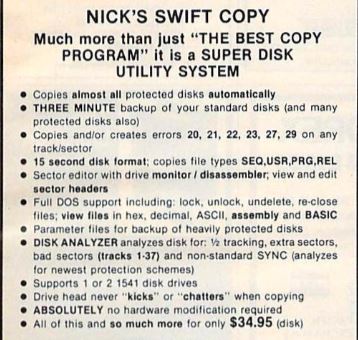
Written by Nick Skreptos and published by his father's company, S.O. Video (which otherwise produced video tapes), Nick's Swift Copy first appeared in November 1984 — at a time when Skreptos was under 18 years old. In a later interview he credited his interest in Apple IIe copy protection as the foundation: many of the same techniques used to protect Apple disks had made their way to the C64, giving him a head start. The program sold between 500 and 700 copies.
Nick's Swift Copy was significantly more capable than its contemporaries for 1984. It included a disk analyzer that could detect errors, half-tracks, extra sectors, and non-standard sync patterns — features that most copiers of the era simply didn't have. The first ad described it as capable of copying "almost all" protected disks, which was an ambitious claim for the time and was substantially accurate for the protection landscape of late 1984.
Speed improvements in Version 2 came from reworking the 1541-to-C64 transfer method and optimising the buffering and assembly code. The program is heavily referenced in the Clone Newsletter back-issues, suggesting it had a loyal user base in the early consumer copying community. Like many tools, it attracted unauthorized copies with credits removed; like Nick Skreptos himself, several parameter systems could duplicate it.
Skreptos stopped development when game companies began threatening legal action. His own copy protection used several techniques over the product's lifetime; the final version physically scratched the innermost tracks of the disk with a pin — if the inner track could be formatted normally, the program concluded it was a copy. When he turned 18, he decided the legal risk was too high and moved to other projects. The manual for v2 is preserved at c64copyprotection.com. Nick's Swift Copy is also referenced in the Lemon64 thread at lemon64.com/forum/viewtopic.php?t=80298.
Canada A/M (Archival Maker) was a commercial disk backup utility published by Skylight Software of Belfast, ME. Advertised from at least 1984, it retailed for $49.99 plus $2.00 shipping. Both a tape version and a disk version were available. The ads promoted it as 'Easy on the User — Easy on your drive,' requiring minimal user intervention. It was rated 4 stars by Info 64 and claimed to handle errors 27 and 29 and duplicate up to 99% of protected software. A contemporary review noted it was a "slow novice level copier without documentation" and that, while it may have been state-of-the-art six months prior to review, Skylight needed to provide regular copy-protection updates to stay competitive. Despite the "A/M" standing for Archival Maker, the program's marketing made clear it was intended as a backup tool for the owner's own originals.
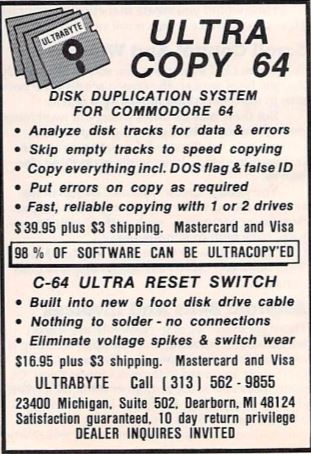
UltraCopy 64 was a disk duplication system for the Commodore 64, written by Jim Lagerkvist and produced by Ultrabyte of Dearborn, Michigan. It was marketed as capable of duplicating 98% of software with a single or two drive setup. Key features: analyse disk tracks for data and errors; skip empty tracks to speed copying; copy everything including DOS flag and false ID; put errors on the copy as required; fast and reliable operation with one or two drives. Price: $39.95 plus $3 shipping.
Ultrabyte also offered a companion product, the C-64 Ultra Reset Switch, built into a new 6-foot disk drive cable with no soldering required. It eliminated voltage spikes and switch wear, priced at $16.95 plus $3 shipping. Both products carried a satisfaction guarantee with a 10-day return privilege. Contact: Ultrabyte, 23400 Michigan Suite 502, Dearborn MI 48124, (313) 562-9855.
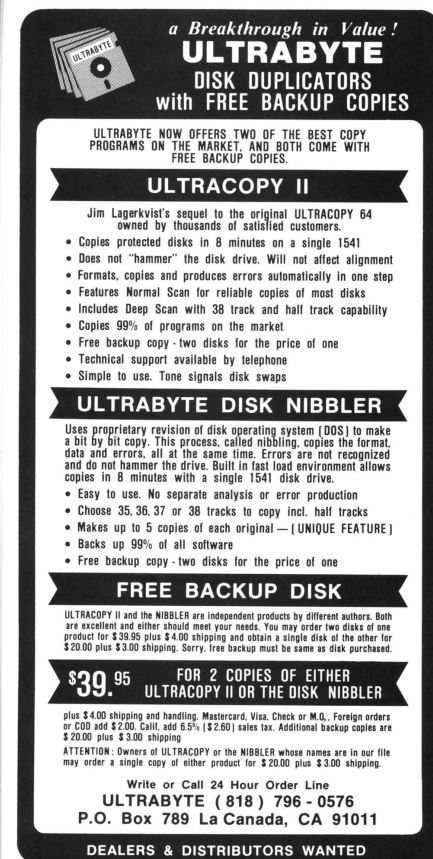
After UltraCopy 64, Ultrabyte relocated to La Cañada, California and launched the Ultrabyte Disk Duplicators line — two companion products sold together as a bundle: UltraCopy II (written by Jim Lagerkvist, a direct sequel to his original UltraCopy 64) and the UltraByte Disk Nibbler (a separate product by a different author). Both shipped together at $39.95 for two copies plus $4.00 shipping, each including a free backup copy.
UltraCopy II used a Normal Scan / Deep Scan architecture: Normal Scan handled the majority of titles; Deep Scan added 38-track and half-track capability for trickier protections. It formatted, copied, and produced errors in a single automated pass, claimed 99% compatibility, and used audible tone signals to prompt disk swaps — a practical touch for single-drive users. UltraByte Disk Nibbler (the companion) used a proprietary nibbling revision of the drive's DOS to copy format, data, and errors simultaneously without the drive seeking repeatedly in a way that stresses alignment. Its headline feature was the ability to produce up to 5 copies of a single original in one session — something no other tool of the period advertised.
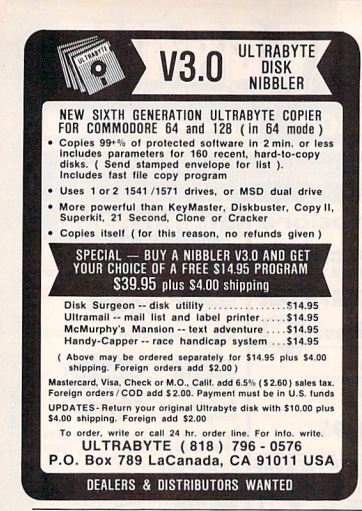
The V3.0 release represented Ultrabyte's own fully in-house successor to both earlier tools, marketed as the "New Sixth Generation UltraByte Copier for Commodore 64 and 128 (in 64 mode)." V3.0 dropped the two-product bundle approach in favour of a single, more capable program: it ran in under 2 minutes on 1 or 2 1541/1571 drives (or MSD dual drives), claimed 99+% compatibility including titles that had defeated earlier tools, and included a fast file copier as part of the package. The ad pointedly named its competition — KeyMaster, DiskBuster, Copy II, 21 Second Backup, Clone, and Cracker — implying V3.0 outperformed all of them. One unusual note: the program could copy itself, which prompted Ultrabyte to print a blunt disclaimer in the ad: "for this reason, no refunds given." Upgrade pricing for existing UltraCopy or Disk Nibbler owners was $10.00 plus $4.00 shipping. A bundle offer added the buyer's choice of one free $14.95 program (Disk Surgeon, Ultramail, McMurphy's Mansion, or Handy-Capper). V4.0 and V5.0 followed and are confirmed in the 1988 "What Copies What?" reference chart, keeping Ultrabyte active in the market through the late commercial era.
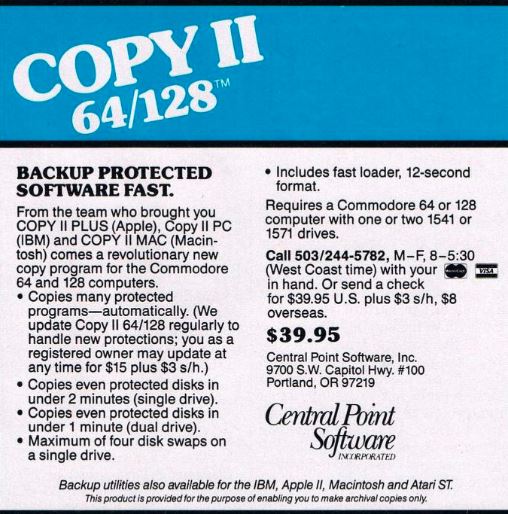
Copy II 64/128 was the Commodore port of Central Point Software's famous Copy II PC product line. It served as both a parameter copier host and a standard disk copier. The 128 version included support for C-128 native mode and 1571 drives. Parameters for Copy II were distributed as separate update disks and covered a broad range of the commercial C64 library.
v1.0–v2.x: Core parameter system with fast copy and basic nybble capability. The parameter selection was scroll-based, with version numbers displayed for each title. v3.x: Improved nybble engine; added density duplication support. v4.0: Final version; the most complete parameter library of the Copy II series; added C-128 specific handling.
A contemporary review noted that Copy II does support the C64 and C128 as well as the 1541 and 1571 disk drives in single or dual configurations, and can examine the hardware present to automatically load the appropriate single or dual mode program. Utility offerings at the time of review were limited to a delete file program and a fast load for BASIC — reviewers would have liked more disk utilities to help users assess protection status before setting parameters. The enclosed parameter leaflet (a physical sheet describing how to configure the program's parameters for specific titles) was considered a limitation: without a disk scanner, users could not check disks not listed on the sheet, making the parameter system liable to become outdated rapidly. This same limitation applied to updates, which were sold at half price. Copy II does not offer anything that distinguishes it enough to justify its $39.95 price point given the competition. The program was considered similar to DiskMaker in offering very little for a high cost, earning a mid-range score from contemporary reviewers pending future improvements.
Cartridge Backer was an early freeze-and-backup cartridge released by Cybertech Software in 1984 — predating ISEPIC (June 1985) by roughly a year and placing it among the earliest cartridge-based backup tools for the C64. The core mechanism was conceptually similar to later freeze cartridges: press a button at the right moment, capture a memory snapshot, and save it to disk. v2.1 is the best-preserved version.
Unlike ISEPIC, which became widely documented and supported through Starpoint's commercial network, Cartridge Backer remained a more obscure product. The cartridge did not require any modification to the drive or the computer beyond insertion into the expansion port. Because it captured the full 64 KB memory state after a protection routine had completed its checks, it was theoretically immune to the class of protection schemes that verified disk authenticity at load time. Games that ran in-session protection checks — verifying the original disk was still present during gameplay — remained out of reach.
DiskBusters was a commercial disk backup utility whose name and logo were a direct play on the 1984 film Ghostbusters — the ad copy described it as being for "Professional Paranormal Disk Back-Up Copying." Version 1 appeared in 1985. Version 2 (1986) was a meaningful upgrade: it added a parameter system able to handle over 100 new protection schemes by zapping through them directly. A Two Drive Adapter Pak was released in 1987 as an add-on, supporting dual-1541 operation and expanding throughput for users duplicating multiple disks. The Two Drive Adapter Pak was one of the last releases in the DiskBusters line, appearing near the end of the product's active period.
The preserved G64 image (v2.0, tracksync-added variant) indicates the disk used a track-sync signature — a light protection measure on the tool's own distribution disk, which was common for copy utilities of the era as a mild deterrent to casual piracy of the copier itself. The UltraByte Disk Nibbler v3.0 ad specifically listed DiskBusters among the programs it claimed to outperform, alongside KeyMaster and Copy II, suggesting DiskBusters had enough market presence to be worth naming as a competitor.
Released by Melody Hall Publishing in 1986, this multi-function disk management and copy utility offered over a dozen commands covering the full range of routine disk operations for the Commodore 64. Its scope extended beyond simple copying: the tool was aimed at users who needed day-to-day disk management as much as backup functionality. Commands included file management, disk analysis, and copying routines. The preserved NBZ image corresponds to the Melody Hall 1986 release and is one of the less-documented tools from the mid-1986 commercial utility wave.
Melody Hall's product filled a practical niche between dedicated nibble copiers (which prioritized protection handling) and single-function fast copiers (which prioritized speed). Tools of this type were increasingly common in 1985–87 as the market segmented: hard-core protection copiers sold to enthusiasts and scene-adjacent users, while general disk managers like this one targeted the wider user base who wanted file copies and simple backups without engaging with protection schemes at all.
Not related to Thomas Tempelmann's FCopy (1983) above — the name is a coincidence.
Creative Micro Designs, better known for the CMD Hard Drive and RAMLink expansion products, also produced a fast copier for their own device ecosystem. CMD FCOPY was designed to copy standard CBM DOS disks via CMD devices (HD, FD2000/4000, RAMLink), but could also operate with standard 1541 drives. The "+" variant added a verify pass and limited error-map support. Significant mainly in the CMD-era context (post-1989), where users migrating from 1541 to CMD hardware needed a utility that could bridge between the two formats. No nybble or protection-bypass capability.
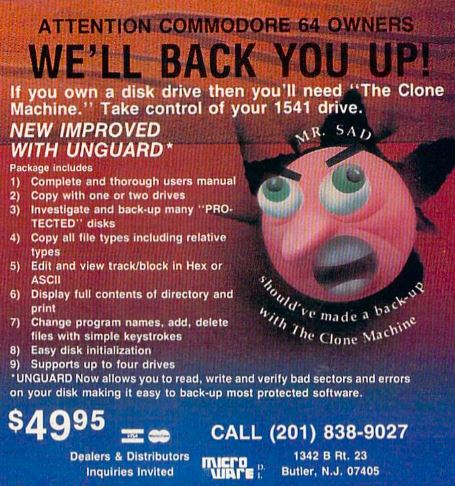
The Clone Machine was published by Micro Wars Inc. of Butler, New Jersey and retailed at $49.95. The package was marketed specifically to Commodore 64 owners with a 1541 disk drive, and included a thorough user's manual covering copy functions, disk investigation, and drive management. The headline addition in the "New Improved with UNGUARD" edition was the ability to read, write, and verify bad sectors — allowing it to back up most protected software that used error-based protection schemes.
The package included: complete users manual, single- and dual-drive copy, investigation and backup of "PRO-TECTED" disks, copy of all file types including relative types, HEX/ASCII track/block editor, full directory display with print support, program name management (add/delete/rename via single keystroke), easy disk initialization, and support for up to four drives. The UNGUARD module extended coverage to titles protected by bad sectors and error-containing tracks. Contact: Micro Wars Inc., 1342 B Rt. 23, Butler NJ 07405, (201) 838-9027.
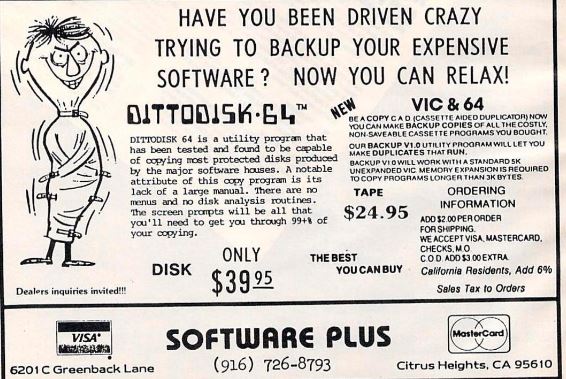
DittoDisk 64 was published by Software Plus of Citrus Heights, California (6201C Greenback Lane; phone (916) 726-8793). It was available in two formats: disk at $39.95 and cassette tape at $24.95. A VIC-20 version also existed (Backup V1.0), requiring a standard 5K unexpanded VIC memory expansion and capable of copying programs loaded from tape. The disk version was tested and found capable of copying most protected disks produced by major software houses, with a claimed 99%+ success rate.
A notable feature of DittoDisk was its minimal interface: no menus and no disk analysis routines. The program was entirely screen-prompt driven — ideal for users who did not want to learn DOS or navigate complex copy utility menus. The ad described it as requiring "no disk analysis routines" and being driven entirely by screen prompts, positioning it firmly in the consumer end of the market. Dealer inquiries were invited, suggesting distribution through retail channels. The VIC cassette companion (Backup V1.0) confirmed that Software Plus were active in the early pre-1541 consumer market before shifting focus to disk.
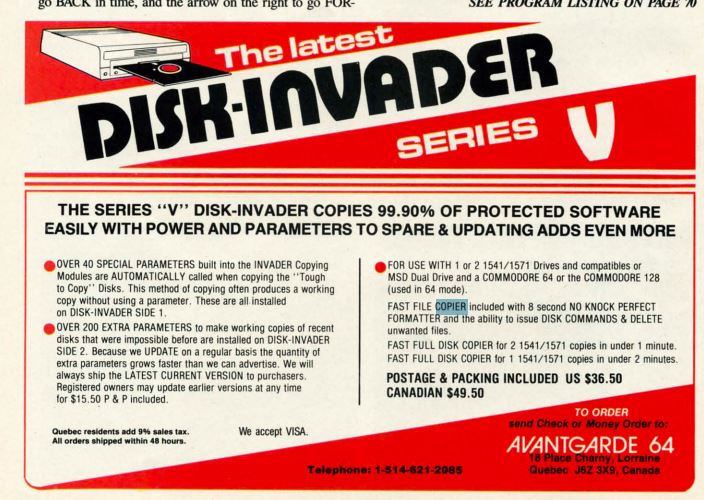
Disk-Invader was published by Avantgarde 64 of Lorraine (18 Place Charny), Quebec, Canada — one of a small number of commercial C64 copy utilities to originate from Quebec alongside 21 Second Backup. It was advertised for use with 1 or 2 1541/1571 drives and compatibles, or an MSD Dual Drive, and supported both the Commodore 64 and Commodore 128 in 64 mode. Telephone orders: 1-514-621-2085; Quebec residents added 9% sales tax; all orders shipped within 48 hours. US price: $36.50; Canadian price: $49.50, postage and packing included.
The Series V shipped on two sides. Side 1 contained the main copying modules plus over 40 built-in special parameters, automatically invoked when copying "Tough to Copy" disks — intended to produce working copies without requiring the user to manually select a parameter. Side 2 contained over 200 extra parameters covering more recent titles. Registered owners were offered updates at $15.50 (postage and packing included), with Avantgarde promising to "always ship the LATEST CURRENT VERSION." Side 1 also included an 8-second no-knock-perfect formatter, a fast file copier, and the ability to issue disk commands and delete files.
Community sources note that Disk-Invader reached at least version 9.9 across its commercial lifetime, and that while it accumulated many features, several were recognized as adapted from other copiers of the era. Avantgarde 64 positioned it against all major competitors on the same basis as most Quebec-produced C64 software: aggressive pricing (US $36.50 was cheaper than Fast Hack'em, Maverick, or Di-Sector) and rapid parameter update turnaround. Turbo Nibbler v1–v4 is separately noted by community sources as a related or companion product released as PAL-only.
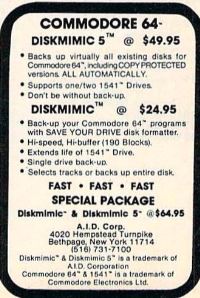
DiskMimic 5 ($49.95) and DiskMimic ($24.95) were two companion products from A.I.D. Corporation of Bethpage, New York. DiskMimic 5 was the more capable product, able to back up virtually all existing disks for the Commodore 64 — including COPY PROTECTED versions — automatically, using a single 1541 drive. Its speed was a key selling point: it operated with Hi-Speed and Hi-Buffer (190 blocks per pass), extended the life of 1541 drives by reducing wear, and could back up an entire disk in a single drive run.
DiskMimic (the standard version) was a disk backup tool for standard Commodore 64 programs, using the SAVE YOUR DISK format. It featured Hi-Speed Hi-Buffer operation (190 blocks), extended 1541 drive life, and single drive copying. A combined Special Package offered both DiskMimic and DiskMimic 5 for $64.95. Contact: A.I.D. Corporation, 4020 Hempstead Turnpike, Bethpage, New York 11714, (516) 731-7100.
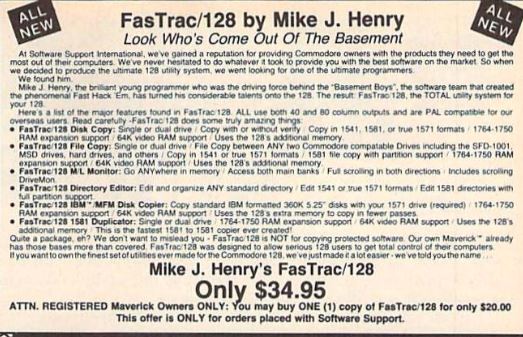
FasTrac/128 is a C128-focused disk utility written by Mike J. Henry (also the creator of Fast Hack'em and early Di-Sector versions) and distributed by Software Support International — the same company behind Maverick and Kracker Jax. It was marketed as "the TOTAL utility system for your 128," developed when SSI recognised there was no equivalent to Fast Hack'em for the 128's expanded capabilities.
Features confirmed in contemporary advertisements: FasTrac/128 Disk Copy (single or dual drive; copy without verify; 1541, 1571, or true 1571 formats; 1764–1750 RAM expansion and 64K video RAM support); File Copy (single or dual drive; between any Commodore-compatible drive including SFD-1001, MSD, hard drives; 1581 file copy with partition support); M/L Monitor (full memory bank access, scrolling both directions); Directory Editor (1541, 1571, 1581 formats with partition support); IBM MFM Disk Copier (copy standard IBM 360K 5.25″ disks using a 1571); 1541 Duplicator (single or dual drive, RAM expansion support). A special offer gave registered Maverick owners a copy for $20.00 against the $34.95 retail price.
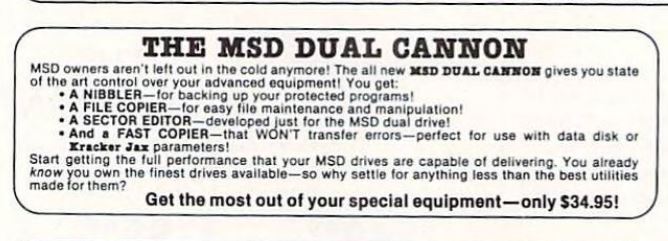
MSD Dual Cannon was a fast copier written specifically to exploit the MSD SD-2 and SD-2D dual disk drives — high-quality 1541-compatible drives manufactured by MSD Company of Dallas, Texas. Where most fast copiers treated the MSD drive as a straightforward 1541 substitute, Dual Cannon used the dual-drive configuration to perform a true parallel read/write pipeline: reading from drive 0 while simultaneously writing to drive 1, eliminating the disk-swap pause entirely for dual-drive users. On a standard 1541 setup the program fell back to conventional single-drive operation, but its target market was clearly the MSD owner who wanted to maximise throughput on the more capable hardware.
The MSD SD-2 drives were faster and mechanically superior to the 1541 — their stepper motor had better head alignment tolerances, and they used a genuine parallel bus internally rather than the 1541's clocked serial approach. Dual Cannon's drive-side code took advantage of this by using tighter timing loops calibrated specifically for MSD hardware. Fast Hack'em v6–v7 later incorporated an "MSD Sure Copy" mode that provided similar optimisation within a full-featured package, but Dual Cannon predates this and was a dedicated standalone utility for MSD owners.
Super Kit/1541 was published by Prism Software of Waco, Texas at $29.95 and written by Joe Peter — also the author of Warp Speed and portions of the VMax copy protection system itself, placing him on both sides of the arms race. It was a comprehensive all-in-one disk utility at a budget price point, with headline dual-drive copy times of 32.68 seconds (normal) and 34.92 seconds (nibble).
Full feature set: Normal Copier (32.68s dual); Nibble Copier (34.92s dual, both with graphics/music loading screen); File Copier (6× normal DOS speed, multi-copy, multi-scratch, BAM view/edit, Super DOS mode); Super Nibbler (claimed to handle any title copyable on a 1541 — Abacus, Timeworks, Accolayde, Epyx, Activision, Electronic Arts explicitly named); Disk Surgeon; Track & Sector Editor (hex/dec/ASCII/binary, monitor/disassembler, printout); GCR Editor (sector-by-sector or track-by-track with Bit Density Scan); Super DOS I (150 blocks in 10.12s); Super DOS II (resident, 150 blocks in 14.87s). Parameters on Side B.
Two 1541s could be daisy-chained and once routines were uploaded to both drives' onboard 6502 RAM, the C64 itself could be disconnected — the drives completed the copy autonomously in around 20 seconds. The program had a deliberate self-protection quirk: Super Kit could copy itself, but a copy of that copy would fail — the original had a shorter sync length that the loader checked, and second-generation copies had a sync too long to pass. V3 was later released to public domain by the author.
Nybble Copiers — Raw GCR Duplication
Nybble copiers read raw GCR data from the disk surface rather than working through CBM DOS. This allows them to reproduce most error states, non-standard sector counts, and some format irregularities that fast copiers completely miss. The price is speed (nybble passes are much slower) and the risk of false-positive errors: a nybbler may "find" errors on a clean disk because the raw data between sectors looks ambiguous to it. The following are the major nybble copiers, roughly in order of capability.
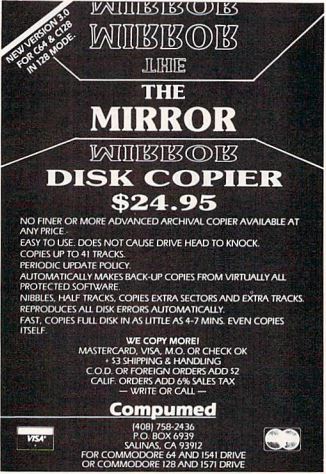
The Mirror was published by Compumed of Salinas, California and retailed at $24.95 — notably cheaper than most competitors. Advertised as "New Version 3.0 for C64 & C128 in 128 Mode," it was claimed to be the most advanced archival copier available at its price, covering nibbles, half-tracks, extra sectors and extra tracks, and automatically reproducing disk errors. Copies finished in as little as 4–7 minutes and the program could even copy itself. The ad specifically promised the drive head would not knock during errors, format, or copying — a dig at copiers like Maverick that were criticized for aggressive drive head banging. A periodic update policy was advertised.
The Mirror appears in the 1988 "What Copies What?" reference chart (preserved at c64copyprotection.com) as versions 3.0, 3.2, and 3.3, confirming it was a live product through the mid-to-late commercial era. The program is confirmed to copy up to 41 tracks. No disk image has been preserved on the major archival sites as of the time of writing.
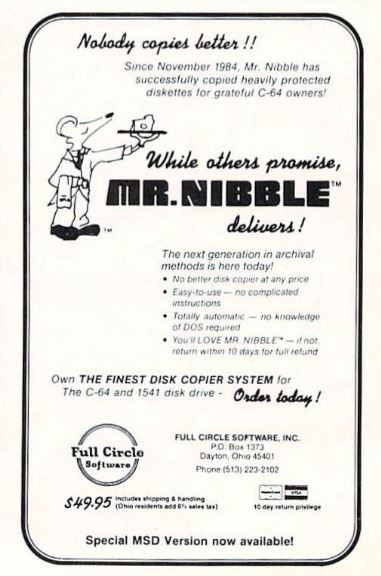
An early dedicated nybble copier available since November 1984, predating the more sophisticated integrated packages. Published by Full Circle Software Inc. of Dayton, Ohio, it was marketed as "the finest disk copier system" for the C64 and 1541 — "no better disk copier at any price." Mr. Nibble read and reproduced raw GCR data including most error conditions (errors 20–23, 27, 29) and had configurable track range (allowing users to copy beyond track 35). Key selling points: totally automatic operation with no knowledge of DOS required, easy-to-use instructions, and a 10-day return-for-full-refund guarantee. A special MSD drive version was also available. Price: $49.95 including shipping and handling (Ohio residents added 6% sales tax).
Limitations: it could not handle truly non-standard GCR encoding (such as V-MAX! or RapidLok), and its handling of all-sync tracks was inconsistent — some versions hung, others skipped them (which defeated the purpose). Nonetheless it was an important step in the development of consumer copy tools and its user-friendly documentation gave many users their first understanding of disk structure. Contact: Full Circle Software Inc., P.O. Box 1373, Dayton OH 45401, (513) 223-2102.
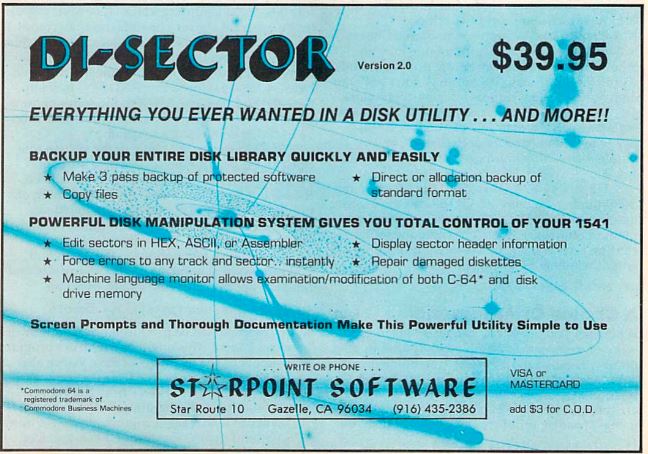
Di-Sector was created by Mike J. Henry and Bruce Q. Hammond of Starpoint Software (Yreka/Gazelle, northern California), with Scott M. Blum also on the team. Versions 1 and 2 were co-authored by Henry and Hammond and released in mid-1984; they represented a genuine breakthrough — the first copier to combine raw nibble copying with a full sector/track editor, track visualisation, and a parameter system in one package. After Henry left Starpoint to found Basement Boys Software, version 3 onward was credited to Hammond and Blum. Info Magazine (December 1985/January 1986) confirmed: "Mike J. Henry struck out on his own after Di-Sector [2.0]."
A hidden Easter egg on the Di-Sector v2 package confirmed Henry's role: the back cover contained binary code that, when decoded, read "SPECIAL THANKS TO MIKE J. HENRY FOR THE NIBBLE AND ARTS BACKUP!!!" Di-Sector's editor could display raw GCR data, modify individual bytes, alter sector headers, and show the Block Allocation Map in real time. Version 3 added improved handling of half-track data and tracks 36–40. Versions 4 and 5 are preserved in online archives. It was during the Di-Sector era that Henry is credited with coining or popularising the term "fat tracks" as a description of the EA/Activision-style wide-track protection.
A contemporary review of version 3.0 found that the fast DOS routines for single and dual drives worked well on both 1541s and 1571s, though the dual disk copier had trouble with certain protection schemes (the single disk copier was problem-free). The parameter copier supported approximately 40 parameters — modest compared to larger systems. A notable disappointment in the advertising versus reality department: the package advertised an "ultra fast file copier" that reviewers found did not exist. The majority of Disector's modules also lacked printer output, a significant omission for a disk utility where being able to print track/sector scan results was highly practical. The disk drive monitor, however, was arguably the most capable drive-side monitor available in any contemporary competing product: it could disassemble unimplemented opcodes, and users who knew 6502 assembly found it an invaluable tool for examining the 1541's internals. A later version added printer output from the monitor. The program was awarded a 7/10 by the reviewer, who recommended its purchase for the drive monitor alone.
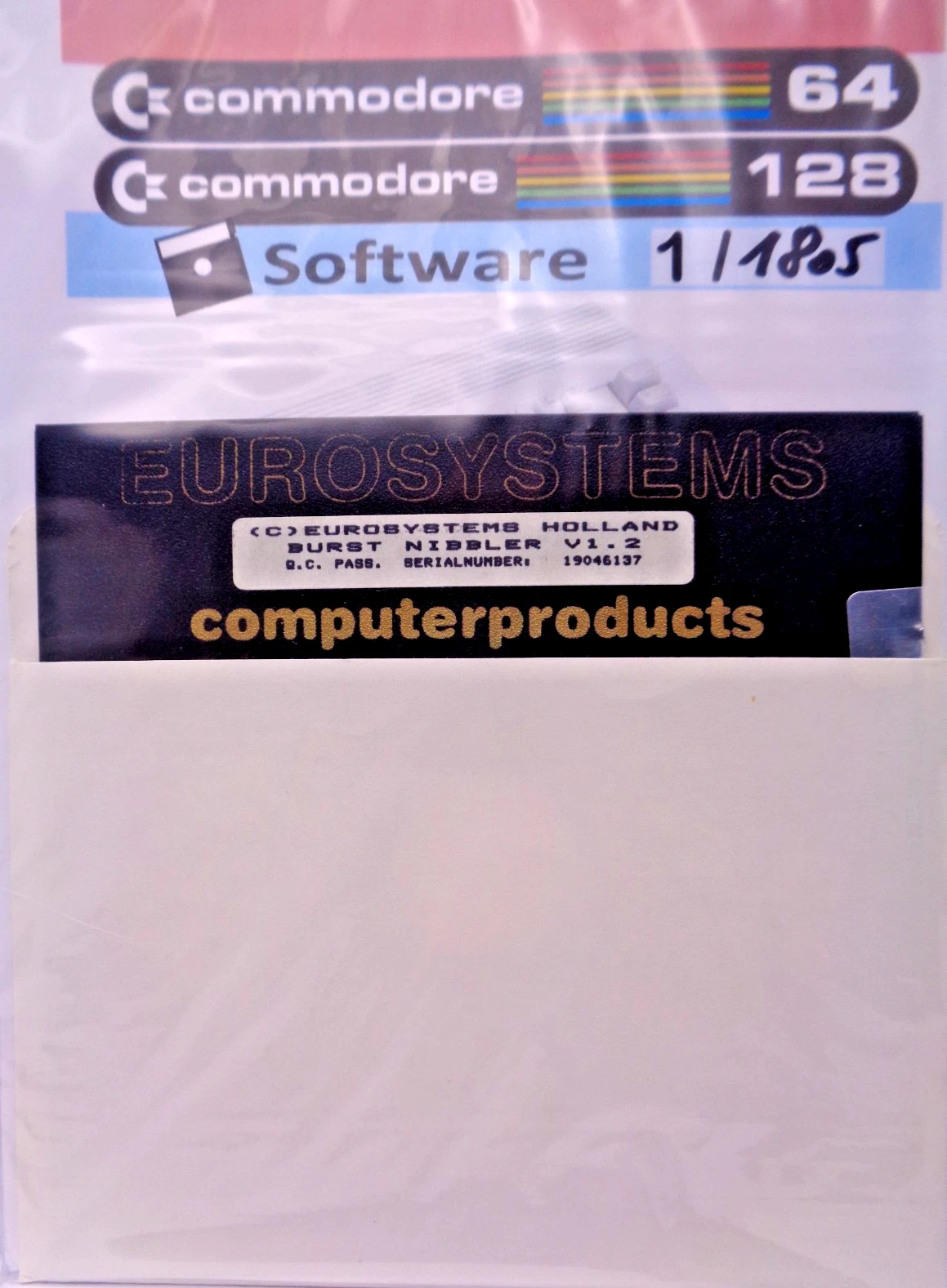
Turbo Nibbler was one of the more capable nybble copiers built for the C64, written by EuroSystems (Eurosystems Computerproducts, Holland). It needed a parallel cable between the C64's user port and the 1541 to hit the burst transfer speeds its name promised. Sidestepping the slow serial bus entirely meant Turbo Nibbler could pull a full track of raw GCR data far faster than any serial-bus nibbler — which mattered a lot when dealing with time-sensitive protection schemes. The software shipped on a 5.25″ floppy and ran on both the Commodore 64 and Commodore 128 in C64 mode.
Version 1 established the core burst-transfer nybble approach and handled most standard protection techniques including bad sectors, extra tracks (36–40), half tracks, and signature tracks. Version 2 tightened the timing loops considerably — v1.2 of the PAL-specific build (as shown on the surviving disk label, serial number 19046137) could read V-MAX! protected tracks more reliably than any serial-bus tool around at the time. The PAL build depended on PAL's 50 Hz interrupt timing for its critical loops and would fall over on NTSC hardware. The parallel cable requirement also made it incompatible with some cartridge port accessories.
The disk label on surviving copies reads: "(C) Eurosystems Holland / Burst Nibbler V1.2 / Q.C. Pass. Serialnumber: 19046137" — reflecting the internal working name used during development, while the marketed product name was Turbo Nibbler.
Across the v1–v4 release history, version 4 is the most widely preserved in community archives and is the build most users came across. Documentation for versions 1–3 is scarce; v4 is the release that most people would recognise as the mature, finished product. Antitrack testing confirmed that Turbo Nibbler v4 could handle gap-protection schemes — titles that checked specific bytes in the inter-sector gap region of the track — though it could be tripped up by an unusually high density of sync marks. No drive ROM modifications were required; a small drive-side routine was uploaded to the 1541's RAM at launch, which is how it managed its timing without touching the firmware.
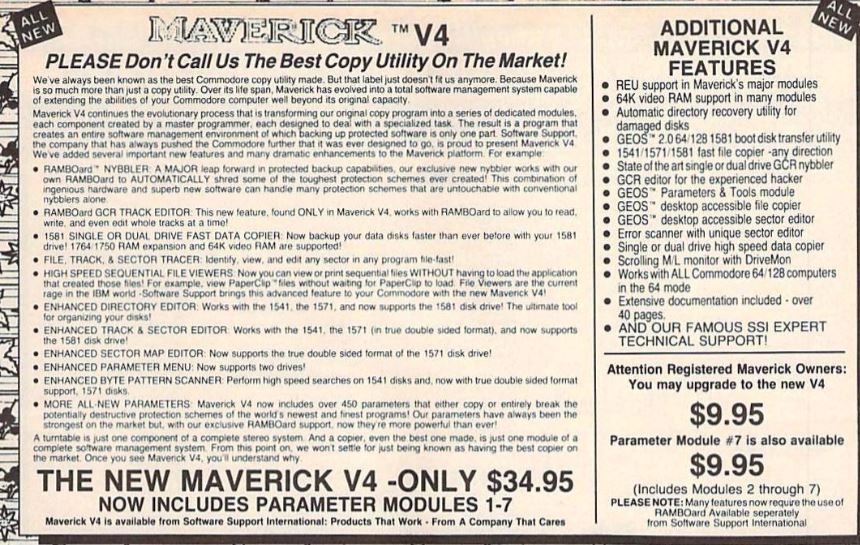
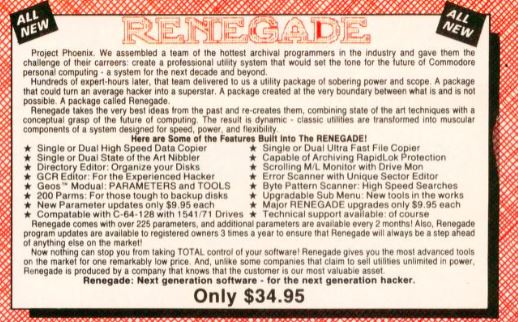
Maverick is the final-generation C64 disk copier — the tool that the scene converged on for the last years of the commercial era. Its predecessor was Renegade, written by Bob Mills and Mike Howard based on a design by Les Lawrence; the name was changed to Maverick because a C64 game called Renegade was already on the market. Early Maverick advertisements still carried a note explaining it was "formerly known as Renegade, not the game." The product was distributed by Software Support International (SSI) of Vancouver, Washington — the same company that distributed Kracker Jax parameters.
Les Lawrence — who ran Kracker Jax from inside a software rental store in Vancouver, Washington — had learned copy protection analysis largely from Jim Drew (creator of Super Parameters / Kracker Pak) through months of direct teaching at Portland-area user group pizza parties. Later Maverick versions expanded the authorship to include David Black III, Daniel Hill, and — critically — Lawrence Hiler (the same person behind Fast Hack'em), confirming a direct working relationship between Maverick and its closest competitor. The graphical user interface — unique among C64 copy tools of the era, giving Maverick a notably more modern look than the text-mode Fast Hack'em — was designed by Wayne Schmidt, a prolific C64 pixel artist. The final release was version 5.04.
Maverick was the first major copier designed with RAMBoard support from the ground up. With a Chip Level Designs RAMBOard installed in the 1541, Maverick could copy a standard single-sided floppy with only a single disk swap on one drive — eliminating the need for a second drive for everyday copies. It also supported the Commodore 1581 3.5" drive, which Fast Hack'em never did. The version history otherwise parallels the main nybbler evolution: v1–v2 core; v3 added full parameter system; v4 expanded GEOS tools; v5 added extended track and density support. The final version 5.04 is the most preserved.
The Renegade/Maverick main menu offered: Fast Data Copier, GCR Nybble Copier, Sector Map Editor, Directory Editor, GCR Format Editor, 6502 M/L Monitor, Parameter Menu, Quick File Copier, GEOS Tool Kit, and Upgrades & Goodies. The GCR Nybble Copier provided configurable track range (default 01–35, adjustable to 40+) and Density Duplication (on/off).
MNIB (later extended and maintained as NIBTools by Pete Rittwage with contributions from multiple preservationists) is not a C64-side tool at all — it runs on a PC and communicates with a 1541 connected via an XE1541/XP1541 parallel cable to a PC parallel port. A parallel port modification to the 1541's internal PCB provides the high-speed data path. MNIB reads raw GCR tracks from the 1541 and saves them as .NIB files (the predecessor to the G64 format) or directly as G64.
NIBTools became the gold standard for preservation-quality image creation of most C64 protections. It has protection-specific command-line flags for the most difficult schemes: -pm for Rainbow Arts/RADWAR/Mindscape long-track variants, full support for RapidLok's angular timing tracks, and PirateSlayer handling in both SPLICE and INDEX modes. It is the tool responsible for the majority of accurately-preserved G64 images in the community archive. Its companion utility nibconv converts between NIB, G64, and D64 formats with protection-type awareness.
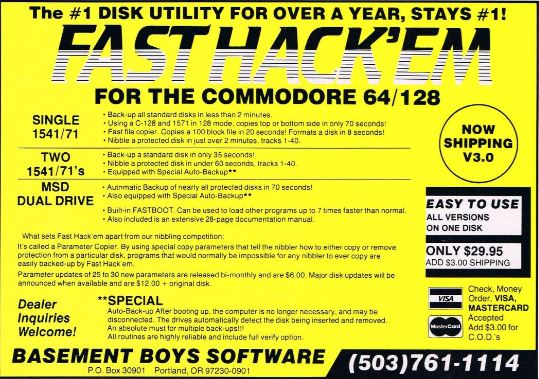
Fast Hack'em was created by Mike J. Henry — widely understood to be a commercial alias for Lawrence Hiler (a.k.a. Mr. Nike), a fact confirmed at Commodore Vegas Expo 2005 where the attendee was listed as "Lawrence Hiller (aka Mr. Nike of Basement Boys Software)." Henry had previously co-authored Di-Sector v1–v2 at Starpoint Software before founding Basement Boys Software, based in Portland, Oregon. The UK distributor was Datel Electronics. The term "fat tracks" — now standard in all C64 protection discussion — was coined or popularised by Henry, as cited by Info Magazine (December 1985/January 1986).
Fast Hack'em v1 launched in 1985 at $29.95 and immediately disrupted the market. Confirmed copy times on v1: unprotected disk in dual-drive mode ~35 seconds; protected disk ~60 seconds — fast enough that Ahoy! Magazine called it "probably the fastest way to copy an entire 1541-formatted disk at the present time." Its signature feature was an autonomous drive-to-drive mode: once Fast Hack'em uploaded its routines to both 1541 drives' onboard RAM, you could literally disconnect the serial cable from the C64 and the two drives would copy indefinitely on their own, using the write-protect LED to detect disk swaps. This was possible because the 1541 contained a full 6502A CPU — Fast Hack'em just had to give it the right program.
The version history: v1–v2 (1984–85): Initial fast copier + nibbler. v3 (1985): Added preliminary parameters; by late 1986 described as handling ~90% of existing software. v4–v5: Expanded parameter libraries; "Deep Nybble" routine for MSD dual drives. v6–v7: "MSD Sure Copy"; 10-second formatter (fastest of any contemporary tool). v8–v9: Most extensive parameter library; improved V-MAX! handling (still could not handle V-MAX! v3+ without RAMBoard). v9.5 (1989): Final version. Basement Boys simultaneously operated as Chip Level Designs for hardware products, including the RAMBOard (memory expansion for 1541/1571 drives) — the very hardware that unlocked V-MAX! v3+ copying. Lawrence Hiler later contributed code directly to Maverick v4–v5, Fast Hack'em's closest competitor.
Parameter Copier Systems
A parameter is a small, self-contained routine — typically 300–800 bytes — that is loaded and executed from within a host copy program. Its function is to apply a specific fix to a copy that does not work: patching bytes, writing specific errors, or otherwise modifying the copy disk to pass a particular title's protection check. One parameter disk could hold approximately 100 parameters (one per commercial title). The concept was transformative: rather than writing a full new copy program for each protected title, developers could write a single small routine per title and distribute updates rapidly.
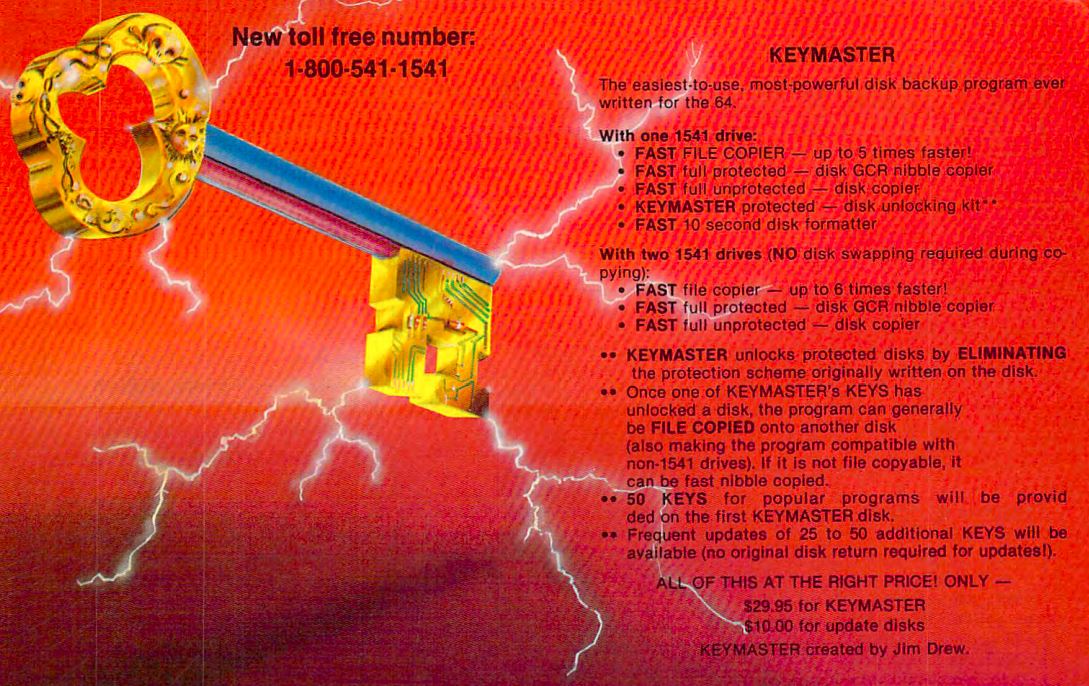
Keymaster was written by Jim Drew, who by this point had already released Gemini and Apollo and was working under contract with Megasoft. Unlike those earlier tools, Keymaster was not primarily a fast copier — it was a parameter-based protection remover. The "keys" in Keymaster were individual routines, each targeting a specific protection scheme on a specific title; the base package shipped with 50 keys, with additional key disks sold separately. Three update disks were released: the Blue Dot (#1), Green Dot (#2), and Red Dot (#3), each adding 25–50 more keys.
The copy component in Keymaster was essentially a fast copier that ran alongside the key system — copy the disk, then apply the relevant key to strip the protection. This two-step approach distinguished it from true nybble copiers like Di-Sector and Turbo Nibbler (EuroSystems), which attempted to reproduce the protection rather than remove it. Keymaster v2.2's manual is preserved and available in PDF form via c64copyprotection.com. Drew went on to build significantly on this approach with Copy II 64 and eventually SuperCard.
A contemporary review noted that Keymaster supports 1541 and 1571 drives in single or dual configurations and copies a single-drive disk in under three minutes, dual drives in under one minute, with a fast format of approximately 10 seconds. File copying uses a fast-load/fast-save approach that moves one file at a time into memory, requiring a disk swap per file regardless of file size — a drawback for anyone moving more than a handful of files. The program comes packaged with 50 parameters, with more available on disk at $10.00 per disk from MegaSoft. A key practical failure: a dual-drive fast file copy test failed due to lack of 1571 support. Registered owners reported not being notified of updates. The two-page manual was considered inadequate. Rated 3/10 by one contemporary reviewer, citing lack of support, high cost relative to features, and hardware limitations.
Super Parameters was written by Jim Drew and distributed by Utilities Unlimited — a company wholly separate from Kracker Jax / SSI. Utilities Unlimited was a spin-off of Megasoft, created by "Reggie" after the Shadow hardware disaster destroyed Megasoft's finances; Drew, who had written all of Megasoft's copy software (Gemini, Apollo, Keymaster, Copy II 64), followed his work there. The Super Parameters disks were sold as a companion to the SuperCard hardware copier family — five volumes in total.
Drew's original product was called Kracker Pak. According to Mr. Drew, Les Lawrence of SSI allegedly named his competing product Kracker Jax to cause confusion — Lawrence later admitted this to Drew directly: "I used Kracker Jax just to cause confusion with your Kracker Pak name." Drew discovered the sabotage when junk bytes he had intentionally embedded in his own Kracker Pak parameters as a fingerprint trap appeared unchanged in early Kracker Jax releases. He subsequently rebranded to Super Parameters. The ripping ran both ways: community analysis later found KJ Vol. 7 and Super Parameters Vol. 5 to be roughly 95% identical in content. Drew was also the central figure who originally taught Les Lawrence how to build parameters — spending roughly six months on it — before Lawrence set up as a direct competitor.
GEOS Busters was a specialized parameter tool from Software Support International's Kracker Jax Product Bureau (KJPB) targeting the copy protection applied to GEOS (Graphic Environment Operating System) and its application library. Berkeley Softworks, the publisher of GEOS, applied protection to the GEOS boot disk and many of its companion applications — protecting the graphical desktop environment differently from standard game protection required purpose-built parameters. GEOS Busters v2 represented SSI's second-generation solution for this specific market segment.
The preservation date is listed as 198x — exact year unconfirmed, late 1980s. SSI's core Kracker Jax volumes handled the game library; GEOS Busters covered the productivity market that GEOS dominated on the C64. The NBZ format preservation indicates the original disk used non-standard formatting that required nibble-level capture.
Kracker Jax was the dominant brand in the C64 commercial parameter market and one of the most vertically integrated copy utility operations of the era. Operating first as Computer Mart then as Software Support International (SSI) at 2700 Andresen Rd, Vancouver WA, the Kracker Jax team produced copy programs, parameter disks, specialist tools, and hardware-assisted utilities across the full C64 commercial period. The Maverick v5 manual explicitly credited Kracker Jax as the origin of the parameters revolution: "The revolution started by Kracker Jax has paved the way for the Maverick."
Parameter Volumes 1–7 were the core product: each disk held approximately 100 parameters and also included a fast copy program (the same fast copier bundled with the GeosBusters disk). Volumes were advertised in Compute!'s Gazette at $19.95, but at $12.95 for Portland-area user group members — a deliberate local loyalty discount. Alongside the volumes, SSI sold Kracker Jax Disks 1–25 directly from their store for $6.95 each, containing 16–18 fresh parameters per disk released as a quick-turnaround format before enough parameters accumulated to fill a full canonical volume. These storefront disks were never magazine-advertised; community members who worked at Centralia Computer Center, a regional Commodore retailer that stocked KJ products, confirmed the practice. The parameters across all releases were also listed in the Original Parameter Cross-Reference up to Vol. 8.
Elite Vol. 1–4 covered titles requiring special-format handling beyond what standard parameters could patch. Renegade v1–v2 was the KJ nibbler/parameter host program; it was renamed Maverick at v2 specifically to avoid confusion with the game of the same name (the ads stated this explicitly). Maverick continued through v3, v4, and v5, the final release, with Maverick parameter disks 1–9 running alongside. Bull's Eye and Shotgun / Shotgun II handled protection classes that defeated standard parameter patching — Bull's Eye was SSI's first entry at the third tier of protection where data couldn't be written out and a parameter alone was useless. Renegade parameter disks 1–3 and the Kracker Jax Hacker's Utility Kit (a disk examination and manipulation toolkit including disk logger, opcode editor, pattern finder, and nibble copier) rounded out the catalog. GEOS Busters (covered separately above) also carried the KJ brand.
SSI also had a formal arrangement with Super Snapshot: the KJ team produced the dedicated Super Snapshot parameter disk, and the Super Snapshot v4 manual explicitly endorsed KJ parameter disks as the best of their type on the market. The cross-contamination with competitors ran both ways — community analysis showed KJ Vol. 7 and Super Parameters Vol. 5 were approximately 95% identical in content, and Jim Drew (Super Parameters) confirmed that parameter ripping in both directions was endemic to the scene.
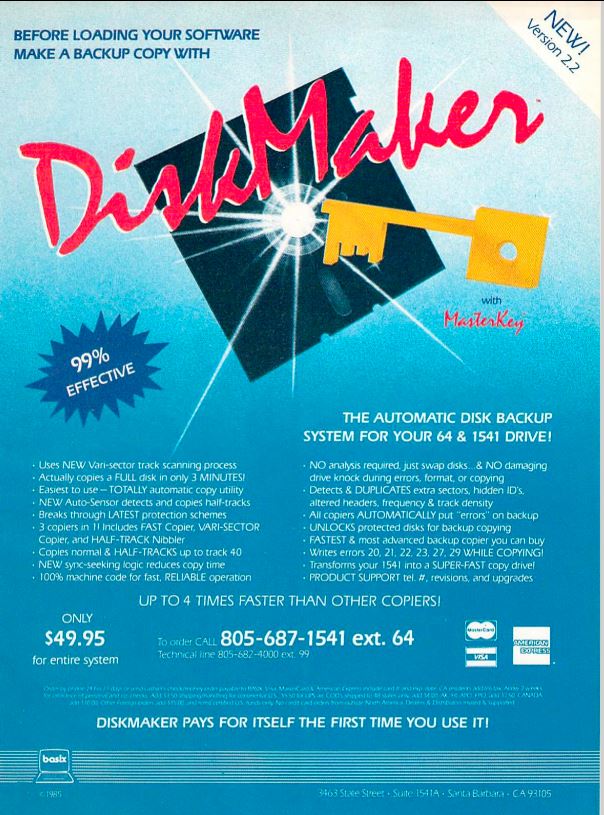
DiskMaker was written by Mike Howard. Version 3.3 incorporated speed increases, but was otherwise a small step forward. The nibbler was updated to use "Masterkey" modules, available individually or via subscription at a premium price. Recent updates also included speed increases during disk copying.
A contemporary reviewer strongly advised Commodore users to avoid this program until it saw vast improvements, and stated that even with improvements it would need to justify its $49.95 retail price. Specific deficiencies cited: no fast copy on two drives, no fast file copier, and no disk utilities — a critical absence given that Basix's own companion product, Toolkit* (advertised for over a year at $39.95), offered the features DiskMaker sorely lacked but was not included. The reviewer noted that the comparison chart clearly showed Basix's product stack to be expensive compared to vendors offering more features for under $30.00. The combination of high base price, expensive update subscription, and limited feature set made DiskMaker one of the few copy utilities to receive a 1/10 from the reviewer — citing high cost, no meaningful added features, and updates that were not vastly improved since version 1.1.
Special Format Copiers
Special format copiers are purpose-built tools designed to handle one specific protection scheme rather than attempting general nybble coverage. By knowing the exact structure of their target format, they can be far more reliable than a general nybbler trying to reverse-engineer the same protection on the fly.
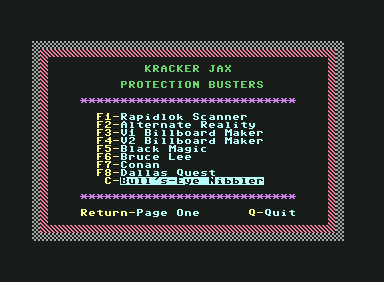
Bulls Eye was designed specifically for Rapid-Lock protection (used primarily by Accolade). Rather than using a general nybbler, Bulls Eye implemented Rapid-Lock's own decoding routine on the copy side, essentially re-encoding the decoded data using Rapid-Lock on the destination disk. This produced a copy that was structurally identical to the original in terms of what the Rapid-Lock loader expected to find. Bulls Eye also included a disk initialization routine that formatted the destination disk in the specific non-standard way Rapid-Lock required. As noted in Back-Ups for Beginners, Bulls Eye was "a special format copier designed to copy Rapid-Locks."
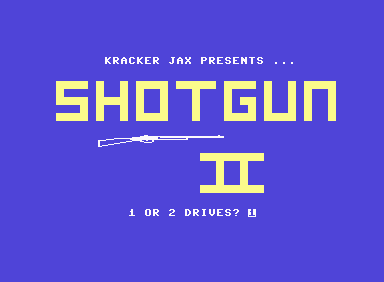
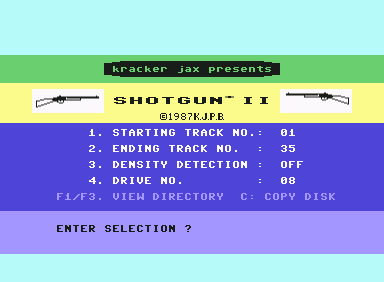
Shotgun II was a nybble copier with built-in Rapid-Lock detection and handling — essentially a general nybbler that had the Rapid-Lock routine embedded as a sub-mode. Per Back-Ups for Beginners, when Shotgun II detected Rapid-Lock protection during a nybble pass, it automatically switched to its Rapid-Lock handling routine rather than trying to nybble the protected tracks raw. This made Shotgun II more versatile than Bulls Eye (which was Rapid-Lock only) while still handling the full Rapid-Lock library. Some advanced users preferred Shotgun II over Bulls Eye because it also covered non-Rapid-Lock titles in a single tool.
Hardware Copiers — Physical Drive Modification
Super-Card was a hardware modification for the 1541 disk drive involving physical chip replacement. It did not speed up the 1541's motor or serial bus — per Back-Ups for Beginners: "Super-Card (Utilities Unlimited), does not speed up the 1541 drive (or make coffee), but it does offer POWER copying." The Super-Card chip(s) replaced one or more standard components inside the 1541's controller board, giving the drive a new and dramatically more capable set of firmware routines.
The Super-Card nybbler routine could copy many newly-released, well-protected titles long before parameters became available for them — when no other nybbler would handle the protection. This made Super-Card essentially the "last resort" in a user's protection-handling toolkit. In theory, according to Back-Ups for Beginners, "Super-Card could back-up ANYTHING." The options menu offered so many choices that using it correctly for a difficult title required either experience or manufacturer support — support that was, as of September 1988, considered lacking.
Installation required opening the 1541, reducing the drive speed slightly, and replacing a chip with a "real steady hand and a TINY screwdriver." The procedure was considered accessible — Back-Ups for Beginners mentions that several non-technical users (described as "housewives" in the source's period language) completed the installation unassisted. Static electricity precautions were essential. GEOS worked perfectly with Super-Card, and the author found only one title (out of hundreds tested) that would not run with the Super-Card drive.
An important quirk: while Super-Card handled most titles, Renegade's nybbler sometimes succeeded where Super-Card failed, and vice versa — neither dominated the other completely across all titles.
Super-Card+ was a redesigned version of Super-Card released specifically to prevent owners of the independently-produced RAMBoard expansion from running Super-Card software. The RAMBoard (a clone of Megasoft's Supercard 8K board) added 8 KB of extra RAM to the 1541 at address $8000, which was also required to copy V-MAX! v3+ disks. When Megasoft redesigned their product as Super-Card+, it included detection code that would fail if RAMBoard hardware was present in the drive. This hardware-level counter-measure against a specific competitor's product is a fascinating example of the "arms race within the arms race" that characterized the C64 copying ecosystem.
While not a copier itself, the RAMBoard (Megasoft's Supercard 8K board) was an essential hardware prerequisite for copying V-MAX! v3+ disks. It placed 8 KB of additional RAM in the 1541 starting at address $8000, expanding the drive's addressable memory from 2 KB to 10 KB. This allowed the full V-MAX! decode buffer to fit in drive RAM, making it possible (with appropriate software) to read the V-MAX! custom encoding without overflowing the buffer. Without RAMBoard (or an equivalent), V-MAX! v3+ copies were simply impossible — the standard 2 KB was insufficient by design. As "Radioactive Warrior" noted in the 1999 comp.sys.cbm thread, RAMBoard combined with the appropriate copy software was the only way to duplicate V-MAX! v3+ on real hardware.
Cartridge Copiers
Epyx FastLoad was the best-selling C64 cartridge ever made. At its peak it sold hundreds of thousands of units and was bundled with new computer packages. It belongs in this section because it was so universal that virtually every copy protection developer had to specifically account for it — most by refusing to boot if it was present.
FastLoad's primary function was a fast disk loader — by installing a replacement serial bus routine in the C64's Kernal vectors and a matching routine in the 1541's RAM, it delivered load speeds roughly 5× faster than the stock bus. It also provided a built-in disk menu (press F1), directory browsing (F3), a basic disk backup, and scratch/rename functions.
Because the cartridge loaded drive-side code into 1541 RAM at boot time, virtually every advanced protection system had to actively detect and reject FastLoad's presence — or its code would corrupt the protection's own drive-side routines. V-MAX! in particular became famous for refusing to load if FastLoad was present. The protection wars of 1986–1991 were partly fought over who controlled the 1541's 2 KB of RAM on boot.
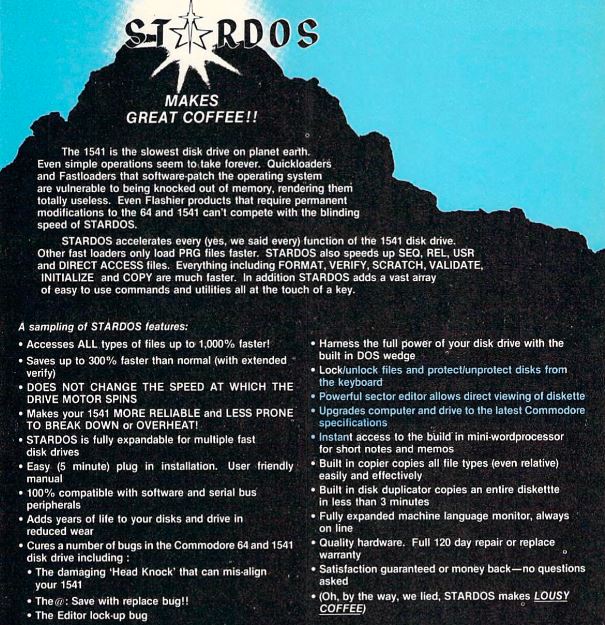
StarDOS was a hardware ROM replacement / DOS wedge device for the Commodore 64 and 1541, marketed with the memorable tagline "The 1541 is the slowest disk drive on planet earth." Rather than a software-only fast loader (like Epyx FastLoad), StarDOS was a quality hardware plug-in with a 120-day repair or replace warranty — described as a "5 minute plug in installation" requiring no soldering. Unlike software-patch fast loaders that could be knocked out of memory by certain programs, StarDOS was hardware-resident and immune to RAM contention.
StarDOS accelerated every disk function — not just PRG file loads. It accessed all file types (PRG, SEQ, REL, USR) up to 1,000% faster, saved at up to 300% of normal speed with extended verify, and added a comprehensive built-in utility suite: FORMAT, VERIFY, SCRATCH, VALIDATE, INITIALIZE, and COPY were all dramatically faster. Included features: a powerful sector editor for direct diskette viewing; machine language monitor (always on-line); built-in copier for all file types including relative files; built-in disk duplicator for entire diskettes in under 3 minutes; lock/unlock and protect/unprotect functions; instant access to a mini word processor for short notes; and DOS wedge commands. StarDOS was expandable to support multiple fast disk drives.
The ad also claimed to cure several known bugs in the Commodore 64 and 1541: the damaging "Head Knock" mis-alignment issue, the @ Save with Replace bug, and the Editor lock-up bug. The ad's closing disclaimer delivered in the same deadpan: "Oh, by the way, we lied. StarDOS makes LOUSY COFFEE."
Super Snapshot was a multi-function cartridge that combined a fast loader, disk DOS utility, sprite multiplexer, machine language monitor, and — critically for copy purposes — a memory capture function. As described in Back-Ups for Beginners, a memory capture is "a complete reading of the computer's memory which is then saved to disk." After running a protected program until it was fully loaded in memory, pressing the Super Snapshot button froze execution and saved the entire 64 KB memory image to disk. This snapshot could then be relaunched without going through the disk-based protection check at all, because the check had already passed before the snapshot was taken.
Two limitations applied: programs that made additional disk accesses after the initial boot would still need the drive, and programs that changed memory vectors that Super Snapshot's own code depended on would cause the cartridge to malfunction. The memory capture approach was often successful against protections that were hard to nybble but easy to boot — including some V-MAX! v1–v2 titles. Fast Hack'em's parameter system referenced "memory capture plus fast copy of disk" as an often-successful composite approach for titles where pure disk copying failed.
Final Cartridge competed directly with Super Snapshot in the multi-function cartridge market, offering fast loading, DOS utilities, ML monitor, freeze/snapshot, and screen dump functions. For copy purposes, its key feature was also the memory freeze/save — identical in principle to Super Snapshot's approach. Final Cartridge was the cartridge most commonly associated with V-MAX! incompatibility: many V-MAX! protected games detected the presence of the Final Cartridge's resident code in drive RAM and refused to boot. This was not a bug in the cartridge — it was V-MAX! defending against tools that might interfere with its drive-side routines.
ISEPIC (pronounced "ice-pick") was created by Chip Gracey — who later co-founded Parallax Inc. with Lance Walley in 1986 and designed the Propeller microcontroller. It was released in June 1985 by Starpoint Software (the same company that produced Di-Sector) at approximately $49.95. Starpoint reported selling 20,000 cartridges within the first year, mostly through computer clubs and mail-order magazines.
ISEPIC's key insight was philosophical rather than technical: instead of trying to defeat copy protection mechanically, it simply waited for the protection to pass. Once a protected game had fully loaded and its protection check had successfully completed, pressing the ISEPIC button froze the machine and saved a complete 64 KB memory snapshot to disk. The resulting snapshot loaded in approximately 10 seconds versus 2–3 minutes for a protected original. The game's protection code was irrelevant, because ISEPIC captured the program after the protection had already decided it was a legitimate disk — like photographing a vault's contents after the door has been opened.
Limitations: ISEPIC did not work on games that ran additional protection checks during gameplay rather than just at boot (some Epyx titles with in-game serial number checks fell into this category). It required a physical freeze to be taken each time, but the resulting snapshot file does run without the cartridge present — making it a genuinely portable backup once the freeze had been captured.
Action Replay was the dominant cartridge copier/utility tool in the European C64 market. Produced by Datel Electronics (the same UK company that distributed Fast Hack'em in Britain), it went through at least seven hardware revisions across the machine's commercial life — where Super Snapshot was the North American standard, Action Replay was the European one.
Core functions across versions: freeze and save (same memory-snapshot approach as Super Snapshot and Final Cartridge), fast loader, disk backup copier, machine language monitor, and sprite/parameter editors. The disk backup function in later versions included a nybble mode. Action Replay's freeze was noted by Pete Rittwage as an explicit target of EA's PirateSlayer protection: some PirateSlayer variants checked for Action Replay's characteristic memory footprint before it even existed on the market — a sign that EA was anticipating future cartridge tools when designing their protection schemes.
Action Replay Mk VI and Mk VII were the most feature-complete versions and remain the most common in European collections today. Datel's dual role as Action Replay manufacturer and Fast Hack'em distributor made them the single most important hardware+software copy utility vendor in the UK market.
Error Writers, Sector Editors & Specialist Tools
The Clone Machine was the flagship product of Micro-W Distributing, publishers of the Clone Newsletter. The original Clone Machine combined a fast copier with a sector/block editor, an error detector (the UNGUARD sub-component), and a track/sector map editor (TCM — Track/Cylinder Machine). It allowed reading and writing individual sectors, inspecting raw track data, and manually setting error states on specific track/sector combinations.
The Clone Newsletter's reader-submitted copy plans almost all reference TCM (the Clone Machine's track copy module) for their step-by-step procedures, e.g., "Copy 3/0 to 17" means use TCM to copy track 3, sectors 0 through 17. The Clone Machine's error-writing capability was central to implementing the specific error-placement recipes published in the newsletter.
SuperClone was the updated version announced on the cover of Clone Newsletter Issue 3b. Key improvements: Unlike the original Clone Machine (which required first copying data and then separately reproducing errors), SuperClone was a one-pass copier that automatically copied all data AND reproduced errors simultaneously — "no more headaches with mixed error tracks." Error 29 was no longer a problem. It also eliminated the drive head banging and rattling associated with UNGUARD's error-scanning approach. SuperClone consisted of three separate programs: SUPERCLONE itself (the one-pass copier), FASTCLONE (a fast version trading screen progress reports for speed), and ERROR DETECTOR (a utility to scan a disk for errors and compare it against the original). As of the newsletter's publication, SuperClone was available as an update to original Clone Machine owners for $10.00 plus shipping.
Unguard was an error detection and creation tool bundled with the Clone Machine. Despite its name and intimidating reputation in the newsletter, Unguard was not a copy program — it was an error-location utility that scanned a disk for all error states and reported their track/sector addresses. This error map was then used to manually recreate those errors on a copy using the Clone Machine's sector editor.
The Clone Newsletter Issue 3b includes a detailed reader-contributed analysis of Unguard's own copy protection (the program protected itself): two safeguards were used. The easy one was an error #27 check on track 9. The harder one was a machine-language routine in the file 'ugsyspk' which loaded to address $C900 and read both a "secret password" ('UG') and a key code ($DC hex = 220 decimal) from a particular track header, using these to unscramble internal routines. The reader's defeat involved unscrambling the code via SYS 51613, patching seven instructions at $C95A–$C96A with NOP instructions, adding LDA #$DC in the cleared area, and deleting the BASIC check lines. The newsletter editor noted that the new SuperClone program would also back up Unguard directly.
Unguard's error-detection scan was described by users as causing significant drive head wear — the constant resetting of the head against the track-1 stop while hunting for errors caused the "banging, clanging, and rattling" that SuperClone was specifically engineered to eliminate.
DiskMaker was the production duplication tool used by Harald Seeley to create V-MAX! protected disks — it is therefore the "other side" of the V-MAX! story, the tool the publisher used rather than the tool the copier used. DiskMaker v3.3b bears the copyright line "V-MAX! © 1985 by Harald Seeley" confirming the direct relationship between DiskMaker versions and V-MAX! protection generations.
Each DiskMaker version corresponded to a specific V-MAX! format generation: v1.0 created V-MAX! v1 format (basic EOR-streaming fast loader, minimal protection); v2.2 created V-MAX! v2 format (added non-standard bit rates); v3.3 created V-MAX! v3 format (the full custom encoding requiring extra drive RAM to copy). DiskMaker Plus was an enhanced version with additional production features for high-volume duplication. From the perspective of the copying community, knowing the DiskMaker version used for a specific title was valuable because it indicated exactly which V-MAX! sub-version was present and therefore which specific copy approach was needed.
ZipCode was a disk image compression and serialisation utility for the C64, not a copy tool in the traditional sense — it did not bypass protection. Instead, it was the primary format used to distribute disk images over BBS systems and early internet archives in the late 1980s and early 1990s. ZipCode split a 1541 disk image into four sequential files (named 1!name, 2!name, 3!name, 4!name) using a simple run-length compression that exploited the large empty sectors typical of most commercial disks. A standard 174,848-byte disk image could be compressed to roughly 60–90 KB depending on content density.
The limitation for preservation: ZipCode worked at the logical sector level — it stored the CBM DOS sector data, not the raw GCR. It therefore had the same constraints as the D64 format: protection-dependent tracks (non-standard formats, weak bits, half-tracks) were either absent or represented as error-flagged sectors. Cracked versions of protected games were almost always what circulated as ZipCode images; original protected disks required G64/NIB format. ZipCode remains significant as the historical distribution format: the majority of C64 software preserved before the introduction of G64 exists in ZipCode form.
Star Commander is a PC-side file manager and disk image utility for C64 disks, operating via an X1541 or XE1541 cable connecting the PC's parallel port to a 1541's serial bus. It provides a Norton Commander-style two-panel interface for copying files between a PC and a 1541 disk, reading and writing D64 images, browsing 1541 directory structures, and converting between CBM and PC file formats.
Star Commander was important as an accessibility tool: it made C64 disk management available to users without a physical C64, and it served as the primary way to write G64/D64 images (created by MNIB/NIBTools) back to real 1541 disks for testing. Its X1541 cable design was widely published and homemade cables became common in the European scene. Not a nybbler and not able to handle protection schemes — for protected disk work, NIBTools was required.